 WhatsApp Us (24/7)
 +91 926 888 0303 (24/7)


To Book an Appointment
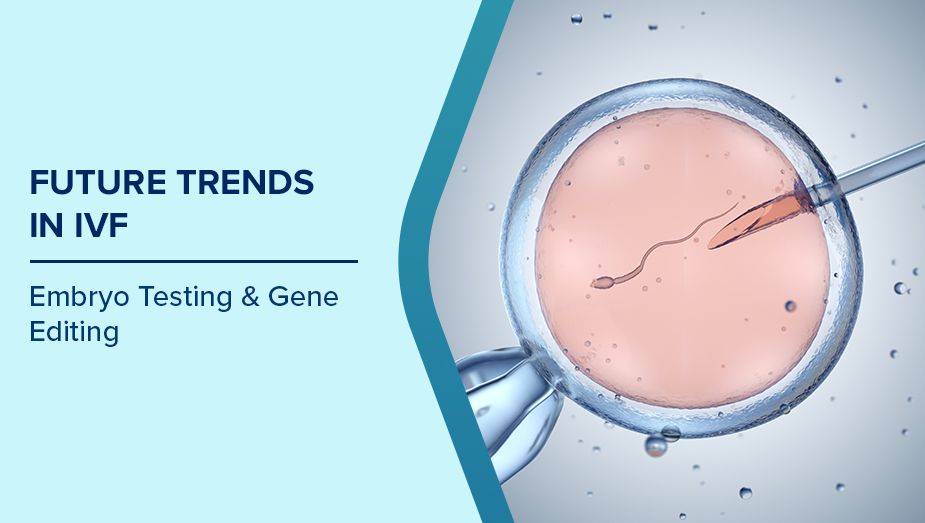
Call Us+91 926 888 0303Future Trends in IVF: Embryo Testing & Gene Editing
By Dr. Soma Singh in Infertility & IVF
Jan 05 , 2026 | 4 min read

Fertility treatment has come a long way over the last four decades. What once felt challenging and uncertain is now more hopeful due to continuous advancements in medical science. In-vitro fertilisation (IVF) has helped many couples become parents, and the future promises even better outcomes with greater comfort and personalisation.
As technology continues to evolve, IVF is no longer just about fertilising an egg in a lab. It's about smarter care, faster decisions, and a deeper understanding of each individual's fertility journey.
Embryo selection through advanced technology:
Selecting the healthiest embryo to transfer is crucial in IVF. Traditionally, embryologists have used a microscope to select embryos based on their appearance. But future methods promise to be much more precise.
- Time-lapse imaging: this technology captures thousands of pictures of embryos as they develop, allowing embryologists to assess subtle growth patterns linked to success.
- Role of Artificial intelligence (AI): One of the most exciting trends is the growing role of artificial intelligence in fertility care. AI can analyse huge databases from thousands of previous IVF cycles to predict which embryos have the highest chance of leading to pregnancy. AI tools can help by minimizing subjectivity and human bias in decisions.
Such advances can reduce the number of IVF cycles needed to achieve pregnancy and may decrease the risk of multiple pregnancies by confidently transferring a single embryo.
Non-Invasive Embryo Testing
Currently, testing an embryo for chromosomal abnormalities (PGT-A) involves taking a few cells from it, which can harm the embryos. Researchers are now exploring non-invasive ways, where genetic material is analysed from the culture fluid in which the embryos grow, to monitor embryo health. This means embryos could be tested without even touching them, preserving their integrity and still being able to get the necessary information to select the best embryos.
Personalised IVF: Tailored fertility treatments
Not everyone’s fertility journey is the same, so treatment shouldn’t be either. Right now, many IVF protocols use a “one-size-fits-most” approach. But in the future, doctors will increasingly use genetic, hormonal and molecular data to design treatment plans tailored to each individual.
- Genomic testing: By studying specific gene variations, doctors may predict how a woman will respond to ovarian stimulation drugs, or identify risks of embryo implantation failure.
- Endometrial receptivity tests: These can pinpoint the exact window when the uterus is most ready to accept an embryo, improving implantation chances.
This level of customization aims to reduce trial and error, lower stress, and improve success rates.
READ MORE: Insight into In-Vitro Fertilisation (IVF): Procedure, Preparation & Risks
Improving egg and sperm quality
Quality of eggs and sperm is a key factor in IVF success. Scientists are exploring methods to improve this:
- Mitochondrial transfers: Mitochondria are the “powerhouses” of the cell, and aging eggs often have weak mitochondria. Experimental techniques aim to rejuvenate eggs by introducing healthier mitochondria from a donor's egg.
- Sperm selection by microfluidics: Instead of standard washing methods for segregating the good sperms from bad ones, microfluidic chips can mimic how sperm naturally swim through cervical mucus, helping select the healthiest and most motile sperm.
Lab-Grown Gametes
Another exciting possibility for the future is the development of lab-grown sperm and eggs from stem cells. Researchers are now working on ways to create the gametes (sperms and eggs) using a person’s own body cells. Scientists in Spain, in 2016, were able to make mature human sperm from a man’s skin cells, but it lacked the capacity to fertilise an egg. Although this is still being researched, it may one day offer new options to individuals who are unable to produce healthy eggs or sperm.
For couples who’ve been told they have no chance of using their own cells, this technology could offer hope for a biological child.
Gene Editing and IVF
Gene editing tools, such as CRISPR, are being studied for their potential to prevent inherited diseases. Though it’s a sensitive topic, some researchers believe that in the future, we may be able to correct certain genetic issues before pregnancy even begins.
This technology is still under careful review and is not yet a part of regular IVF. However, it demonstrates how far science is striving to make healthier pregnancies possible for everyone.
A Future Full of Possibilities
IVF is already a life-changing procedure for many families, and these innovations are making it even more accessible, personalised, and effective. Whether it's using AI for smarter decisions, developing non-invasive methods, or exploring new scientific frontiers, the goal remains the same: to help people experience the joy of parenthood in a way that feels right for them.
If you're planning to explore fertility treatment, keep in mind that IVF is constantly evolving. The choices you have today may be very different from what will be available tomorrow. Stay informed, ask questions, and work closely with a fertility expert who understands your journey.
Conclusion
The future of IVF is full of promise. With new technologies making treatment more personalised, accurate, and gentle, the journey to parenthood is becoming easier and more hopeful. But beyond technology, what matters most is empathy, support, and holistic care.
Frequently Asked Questions
Will AI in IVF replace the need for doctors?
No, AI just supports doctors by providing them with more accurate insights. Fertility specialists still make all final decisions, combining AI tools with their expertise and personal care.
Can IVF be successful without egg retrieval in the future?
Current IVF still needs egg retrieval, but research is ongoing to create alternatives like lab-grown eggs. These methods are not yet ready for use but may become available in the future.
What is personalised IVF and how is it different?
Personalised IVF focuses on adjusting treatment based on your unique health, hormone levels, and past experiences. It aims to make the process more efficient and suited to your body.
Are gene-editing technologies used in IVF today?
Gene editing is still under research and is not part of routine IVF. It may be used in the future for the treatment of serious inherited diseases, but strict safety and ethical guidelines must be followed.
Written and Verified by:

Related Blogs

Dr. Richa Singh In Infertility & IVF
Nov 08 , 2020 | 2 min read

Dr. Richa Singh In Infertility & IVF
Nov 08 , 2020 | 2 min read
Blogs by Doctor
World IVF Day 2025: Raising Awareness about Infertility and IVF
Dr. Soma Singh In Infertility & IVF
Jul 07 , 2025 | 11 min read
IVF Success Rate by Age: How Fertility Changes Over Time
Dr. Soma Singh In Infertility & IVF
Jul 18 , 2025 | 4 min read
Most read Blogs


Related Blogs
Dr. Richa Singh In Infertility & IVF
Nov 08 , 2020 | 2 min read
Dr. Richa Singh In Infertility & IVF
Nov 08 , 2020 | 2 min read
Blogs by Doctor
World IVF Day 2025: Raising Awareness about Infertility and IVF
Dr. Soma Singh In Infertility & IVF
Jul 07 , 2025 | 11 min read
IVF Success Rate by Age: How Fertility Changes Over Time
Dr. Soma Singh In Infertility & IVF
Jul 18 , 2025 | 4 min read
Most read Blogs