 WhatsApp Us (24/7)
 +91 926 888 0303 (24/7)


To Book an Appointment
Call Us+91 926 888 0303Robotic vs Open Prostate Surgery: Recovery, Risks & Key Differences
By Dr. Juned Shaikh in Urology , Kidney Transplant , Robotic Surgery
Jun 24 , 2026

Prostate surgery is a common treatment option for conditions such as prostate cancer and, in some cases, severe benign prostate enlargement. With advances in surgical technology, patients today often hear about two main approaches: robotic-assisted prostate surgery and traditional open prostate surgery.
Choosing between these methods can feel overwhelming, especially when both aim to achieve the same goal: safe and effective removal of the prostate while preserving quality of life. Understanding how these procedures differ, their benefits, and their limitations can help patients make a more informed decision in consultation with their surgeon.
Understanding Prostate Surgery
Prostate surgery, most commonly referred to as prostatectomy, involves the removal of part or all of the prostate gland. It is typically recommended for:
- Localised prostate cancer
- Selected cases of advanced prostate conditions
- Situations where other treatments are not suitable
The goal of surgery is not only to remove diseased tissue but also to preserve important functions such as urinary control and sexual function as much as possible.
What Is Open Prostate Surgery?
Open prostate surgery is the traditional method, where the surgeon makes a single larger incision in the lower abdomen to access and remove the prostate gland.
Key Features
- Direct visual access to the prostate
- Performed through a single incision
- Requires manual surgical techniques
- Usually done under general or spinal anaesthesia
When It Is Used
Open surgery may still be recommended in:
- Complex or advanced cases
- Situations where robotic systems are not available
- Patients with specific anatomical considerations
What Is Robotic Prostate Surgery?
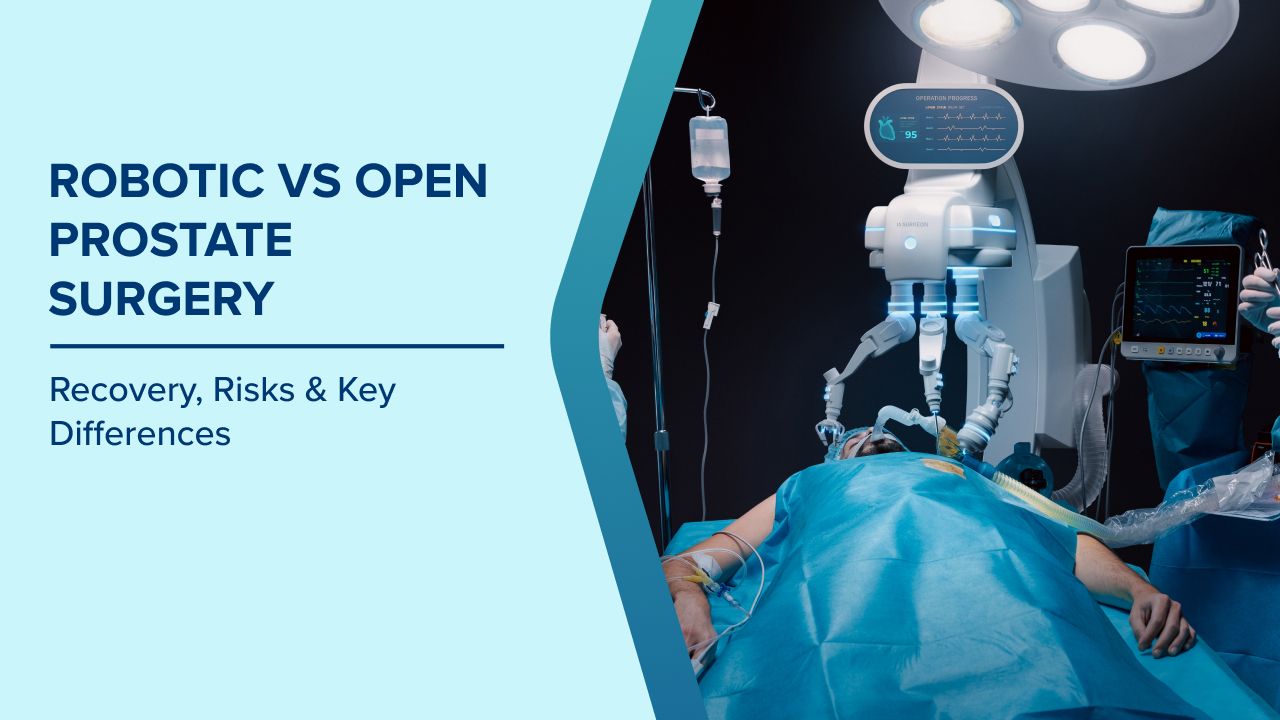
Robotic-assisted prostate surgery is a minimally invasive technique that uses advanced robotic systems controlled by the surgeon.
The surgeon operates from a console, guiding robotic arms that perform the procedure through small keyhole incisions.
Key Features
- Minimally invasive approach
- High-definition, magnified 3D view
- Greater precision and control
- Smaller incisions compared to open surgery
How It Works
The robotic system translates the surgeon’s hand movements into precise micro-movements, allowing better access to delicate structures such as nerves and blood vessels.
Robotic vs Open Prostate Surgery: Key Differences
Surgical Approach
- Open Surgery: Single large incision
- Robotic Surgery: Multiple small incisions
Robotic surgery is less invasive, which often leads to reduced trauma to surrounding tissues.
Precision and Visualisation
- Open Surgery: Direct view with standard visual field
- Robotic Surgery: Magnified 3D high-definition view
Robotic systems allow surgeons to see fine anatomical details more precisely, which can be helpful in nerve-sparing procedures.
Blood Loss
- Open Surgery: Generally associated with higher blood loss
- Robotic Surgery: Typically involves less blood loss
Minimally invasive techniques help reduce bleeding during the procedure.
Pain and Recovery
- Open Surgery: More post-operative discomfort and longer recovery
- Robotic Surgery: Less pain and quicker recovery in many cases
Patients undergoing robotic surgery often return to daily activities sooner.
Hospital Stay
- Open Surgery: Longer hospital stay
- Robotic Surgery: Shorter hospital stay in most cases
However, this can vary depending on the patient’s overall health and recovery.
Scarring
- Open Surgery: Noticeable scar due to larger incision
- Robotic Surgery: Minimal scarring
For many patients, this cosmetic difference is an important consideration.
Functional Outcomes
Preserving urinary control and sexual function is a key concern.
- Open Surgery: Good outcomes in experienced hands
- Robotic Surgery: May offer improved precision for nerve preservation
Results depend significantly on the surgeon’s experience rather than the technique alone.
Advantages of Robotic Prostate Surgery
Robotic-assisted procedures offer several potential benefits:
- Smaller incisions and reduced tissue trauma
- Less blood loss during surgery
- Lower risk of complications in selected cases
- Faster recovery and earlier return to routine activities
- Improved visual clarity for delicate surgical steps
These advantages make robotic surgery a preferred option for many patients when available and appropriate.
Advantages of Open Prostate Surgery
Despite newer techniques, open surgery still has its place:
- Effective for complex or advanced conditions
- Does not require specialised robotic equipment
- Suitable for settings where robotic systems are unavailable
- Proven track record over many years
In experienced hands, open surgery can provide excellent outcomes.
Possible Risks
All surgical procedures carry some level of risk, regardless of the approach.
Common Risks Include
- Infection
- Bleeding
- Urinary incontinence
- Erectile dysfunction
- Anaesthesia-related complications
The likelihood of these risks varies depending on:
- Patient health
- Stage of disease
- Surgical expertise
- Post-operative care
Which Option Is Better?
There is no single answer that applies to everyone. The “better” option depends on individual factors.
Robotic Surgery May Be Preferred If:
- The condition is detected at an early stage
- Minimally invasive surgery is suitable
- Faster recovery is a priority
- Access to advanced surgical facilities is available
Open Surgery May Be Preferred If:
- The case is complex or advanced
- Robotic systems are not accessible
- The surgeon recommends it based on clinical evaluation
The Role of Surgeon Expertise
One of the most important factors influencing outcomes is the surgeon’s experience.
A highly skilled surgeon using either technique can achieve:
- Better cancer control
- Improved functional outcomes
- Lower complication rates
Patients should feel comfortable discussing:
- The surgeon’s experience
- Expected outcomes
- Potential risks
- Recovery timeline
Recovery After Prostate Surgery
Recovery varies from person to person, but some general points include:
Initial Recovery
- Hospital stay for monitoring
- Use of a urinary catheter for a short period
- Pain management and wound care
Gradual Return to Routine
- Light activities within a few weeks
- Avoiding heavy lifting initially
- Follow-up visits to monitor recovery
Long-Term Recovery
- Improvement in urinary control over time
- Gradual return of sexual function in some cases
- Regular follow-ups for monitoring
Recovery is usually faster after minimally invasive procedures, but individual experiences may vary.
Lifestyle After Surgery
Maintaining overall health plays a key role in recovery and long-term outcomes.
Helpful Measures
- Balanced diet with adequate nutrition
- Regular physical activity as advised
- Avoiding smoking and excessive alcohol
- Managing underlying conditions like diabetes or hypertension
These steps support healing and overall well-being.
When Should You Consult a Specialist?
You should consider consulting a specialist if you experience:
- Persistent urinary symptoms
- Difficulty in urination
- Blood in urine
- Diagnosis of prostate cancer
- Concerns about treatment options
Early consultation allows better planning and informed decision-making.
Conclusion
Robotic and open prostate surgeries are both effective approaches with their own advantages. While robotic surgery offers the benefits of minimally invasive techniques and faster recovery, open surgery remains a reliable option, especially in complex cases.
Rather than focusing solely on which method is “better,” the decision should be based on individual medical needs, the stage of the condition, and the expertise of the surgical team. Open and informed discussions with your doctor are essential to choose the most suitable approach.
Frequently Asked Questions (FAQs)
1. Is robotic prostate surgery more expensive than open surgery?
Robotic surgery can be more costly due to advanced technology and equipment. However, overall expenses may vary depending on hospital stay, recovery time, and individual treatment needs.
2. How long does recovery take after prostate surgery?
Recovery varies, but most patients resume normal activities within a few weeks, with gradual improvement over time.
3. Will surgery affect urinary control?
Temporary urinary incontinence can occur, but it often improves with time and appropriate care.
4. Can sexual function be preserved after surgery?
It may be preserved in some cases, especially with nerve-sparing techniques, but outcomes vary.
5. Is robotic surgery suitable for all patients?
No, suitability depends on individual health, disease stage, and clinical evaluation.
Written and Verified by:

Related Blogs

Dr. Anant Kumar In Urology , Kidney Transplant , Uro-Oncology
Nov 08 , 2020 | 8 min read

Dr. Shailendra Kumar Goel In Urology , Kidney Transplant , Uro-Oncology
Nov 08 , 2020 | 4 min read
Blogs by Doctor

Most read Blogs


Related Blogs
Dr. Anant Kumar In Urology , Kidney Transplant , Uro-Oncology
Nov 08 , 2020 | 8 min read
Dr. Shailendra Kumar Goel In Urology , Kidney Transplant , Uro-Oncology
Nov 08 , 2020 | 4 min read
Blogs by Doctor
Most read Blogs