 WhatsApp Us (24/7)
 +91 926 888 0303 (24/7)


To Book an Appointment
Call Us+91 926 888 0303Open vs Closed Rhinoplasty: Benefits and Recovery
By Dr. Ashish Rai in Aesthetic And Reconstructive Surgery , Hair Transplant
Mar 18 , 2026

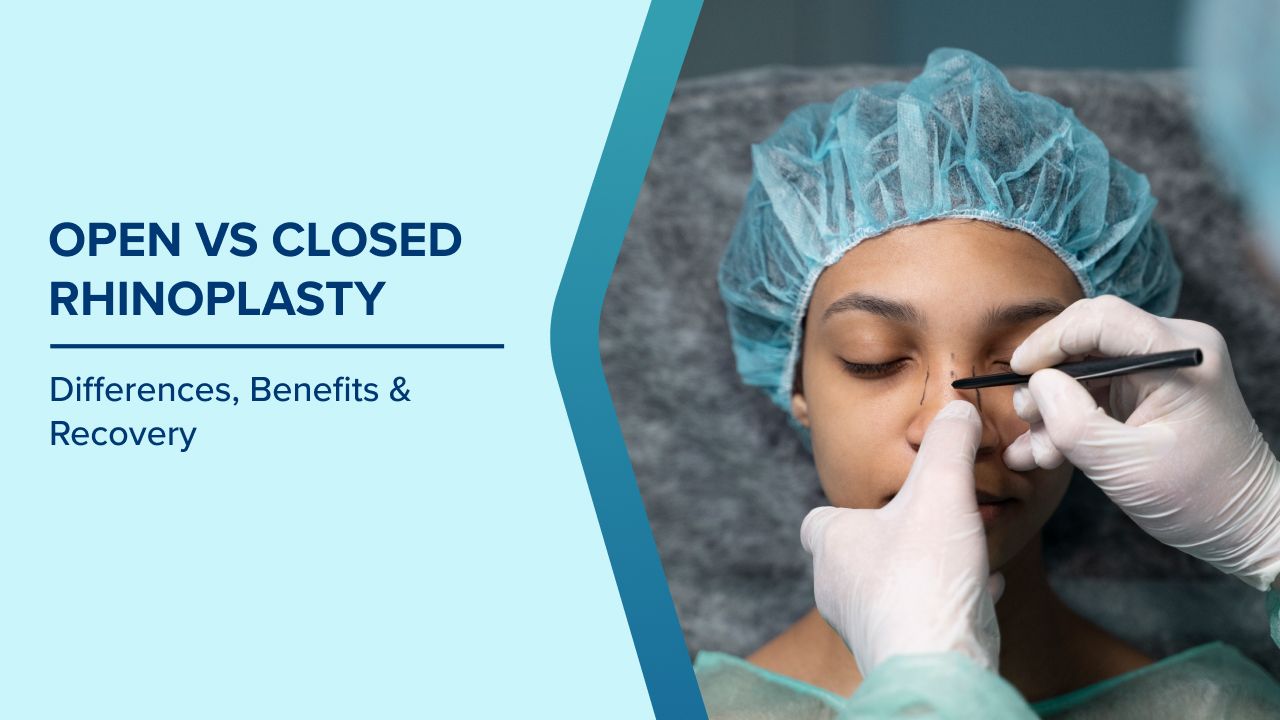
Rhinoplasty, commonly known as nose reshaping, is one of the most popular cosmetic procedures worldwide. It is performed to improve the appearance of the nose, correct structural problems, or enhance breathing function. Two main rhinoplasty techniques are used by surgeons: open rhinoplasty and closed rhinoplasty. Both approaches aim to achieve natural-looking rhinoplasty results, but they differ in terms of surgical access, recovery time, and scar visibility. Understanding the differences between open and closed rhinoplasty helps patients and surgeons choose the most suitable method based on individual anatomy, goals, and complexity of the procedure.
What is Rhinoplasty?
Rhinoplasty is a surgical procedure that reshapes or reconstructs the nose. Often referred to as cosmetic nose surgery or nose reshaping surgery, it can address both aesthetic concerns and functional issues. People choose rhinoplasty for several reasons:
- Improving the overall appearance of the nose
- Correcting a crooked or asymmetrical nose
- Reshaping the nasal tip or bridge
- Reducing or increasing nose size
- Repairing nasal deformities from injury
- Improving breathing difficulties caused by structural problems
Rhinoplasty can be performed using different rhinoplasty techniques, but the two most widely used approaches are open rhinoplasty and closed rhinoplasty.
What is Open Rhinoplasty?
Open rhinoplasty is a surgical technique where the surgeon makes a small incision across the columella, the strip of tissue between the nostrils. This allows the skin of the nose to be gently lifted, giving the surgeon a clear view of the nasal structures.
How the Open Rhinoplasty Procedure Works
During the rhinoplasty procedure, the surgeon:
- Makes a small external incision at the base of the nose.
- Lifts the nasal skin to expose cartilage and bone.
- Reshapes the nasal framework using surgical instruments.
- Repositions the skin and closes the incision with fine sutures.
When Surgeons Prefer Open Rhinoplasty
Open rhinoplasty is often recommended for:
- Complex nasal deformities
- Major structural reshaping
- Tip refinement or reconstruction
- Revision rhinoplasty procedures
- Severe asymmetry or trauma-related cases
Because the nasal structures are fully visible, surgeons can perform highly precise modifications.
What is Closed Rhinoplasty?
Closed rhinoplasty is another common technique where all surgical incisions are made inside the nostrils, meaning there are no external cuts on the skin.
How Closed Rhinoplasty Works
In a closed rhinoplasty procedure, the surgeon:
- Creates small incisions inside the nasal passages.
- Accesses cartilage and bone through internal openings.
- Reshapes the nasal structure using specialised instruments.
- Closes the internal incisions with dissolvable sutures.
When Closed Rhinoplasty is Recommended
Closed rhinoplasty may be ideal for:
- Minor nasal reshaping
- Small dorsal hump removal
- Subtle tip adjustments
- Patients concerned about visible rhinoplasty scars
- Cases requiring shorter nose surgery recovery
Because the nasal skin is not lifted completely, the surgical field is more limited, but the procedure is less invasive.
Read More: Deviated Nasal Septum: When Does It Need Surgery?
Key Differences Between Open and Closed Rhinoplasty
Understanding the differences between open and closed rhinoplasty helps patients evaluate which approach may be suitable for their needs.
Incision Placement
- Open rhinoplasty: Small external incision on the columella
- Closed rhinoplasty: All incisions hidden inside the nostrils
Visibility of Scars
- Open rhinoplasty: Minimal external scar, usually fades over time
- Closed rhinoplasty: No visible external scars
Surgical Access
- Open rhinoplasty: Provides full access to nasal anatomy
- Closed rhinoplasty: Limited surgical visibility
Procedure Complexity
- Open rhinoplasty: Better for complex or reconstructive cases
- Closed rhinoplasty: Ideal for simpler cosmetic adjustments
Recovery Time
- Open rhinoplasty: Slightly longer rhinoplasty recovery time
- Closed rhinoplasty: Faster recovery with less swelling
Swelling
- Open rhinoplasty: More postoperative swelling initially
- Closed rhinoplasty: Usually less swelling
Advantages of Open Rhinoplasty
Many surgeons prefer this approach for complex procedures because of the improved surgical visibility it provides. Benefits of open rhinoplasty include:
- Greater precision during surgery
- Better visibility of cartilage and bone structures
- More effective correction of complex deformities
- Ideal for revision rhinoplasty cases
- Improved accuracy in reshaping the nasal tip
Although a small incision is made externally, modern surgical techniques ensure that rhinoplasty scars are minimal and fade over time.
Advantages of Closed Rhinoplasty
Closed rhinoplasty is considered a minimally invasive rhinoplasty technique and offers several advantages for suitable patients. Advantages of closed rhinoplasty include:
- No visible external scars
- Shorter surgical time
- Faster nose surgery recovery
- Less swelling and bruising
- Reduced risk of certain complications
Because the skin is not lifted extensively, tissue trauma is minimised, which can help accelerate healing.
Read More: Managing Nasal Congestion: Causes, Treatments, and Home Remedies
Which Rhinoplasty Technique is Better?
When comparing open vs closed rhinoplasty, there is no universally “best” technique. The ideal method depends on several individual factors.
- Nose Structure: Patients with complex nasal structures often benefit from the improved visibility offered by open rhinoplasty.
- Complexity of Correction: Minor cosmetic changes may be effectively addressed with closed rhinoplasty, while significant reshaping may require an open approach.
- Surgeon Expertise: The experience and skill of the surgeon play a crucial role in achieving optimal rhinoplasty results.
- Revision Surgeries: Revision rhinoplasty often requires open rhinoplasty because the surgeon needs greater access to previously altered structures.
- Patient Goals: Personal goals, such as minimising scars or achieving dramatic changes, can also influence the choice of technique.
Ultimately, the best rhinoplasty technique is the one that safely achieves the desired aesthetic and functional outcome.
Recovery Time and Healing
Recovery is an important consideration for anyone considering cosmetic nose surgery.
Immediate Recovery
After rhinoplasty surgery, patients may experience:
- Swelling
- Bruising around the eyes
- Nasal congestion
- Mild discomfort
These symptoms are usually temporary and improve within a few days.
Healing Timeline
- 1 week: Splint removal and reduction of initial swelling
- 2–3 weeks: Bruising significantly improves
- 1–3 months: Most swelling resolves
- 6–12 months: Final rhinoplasty results become visible
Swelling may last slightly longer after open rhinoplasty, but both techniques eventually provide similar long-term outcomes.
Risks and Complications
Like any surgical procedure, rhinoplasty surgery carries some risks. Possible rhinoplasty risks include:
- Infection
- Bleeding
- Breathing difficulties
- Nasal asymmetry
- Prolonged swelling
- Unsatisfactory cosmetic outcome
- Need for revision rhinoplasty
Who is the Ideal Candidate for Each Technique?
Ideal Candidates for Open Rhinoplasty
Open rhinoplasty may be suitable for patients who:
- Require major nasal reshaping
- Have complex nasal anatomy
- Need structural reconstruction
- Are undergoing revision surgery
- Need detailed tip refinement
Ideal Candidates for Closed Rhinoplasty
Closed rhinoplasty may benefit individuals who:
- Need minor cosmetic adjustments
- Want minimal downtime
- Prefer no visible scars
- Have relatively simple nasal anatomy
A thorough consultation with a plastic surgeon helps determine the most appropriate surgical approach.
Read More: Sinus Infection: Causes, Lifestyle Factors & Prevention Tips
Conclusion
Both open and closed rhinoplasty techniques are effective methods for performing nose reshaping surgery, but they serve different purposes. Open rhinoplasty provides greater visibility and precision for complex corrections, while closed rhinoplasty offers faster recovery and no visible scars for simpler procedures. The best approach depends on the patient’s nasal anatomy, aesthetic goals, and the surgeon’s expertise. Consulting a qualified, board-certified plastic surgeon is essential to determine the most appropriate technique and achieve safe, natural-looking rhinoplasty results.
Frequently Asked Questions
Is open rhinoplasty more painful than closed rhinoplasty?
Pain levels are generally similar for both techniques because patients receive anaesthesia and postoperative pain management. However, open rhinoplasty may involve slightly more swelling during the initial healing period.
How long does swelling last after rhinoplasty?
Most swelling subsides within 3 months, but subtle swelling, especially at the nasal tip, can take up to 1 year to completely resolve.
Can rhinoplasty improve breathing problems?
Yes, rhinoplasty can correct structural issues such as a deviated septum or collapsed nasal valves, improving airflow and breathing function.
How soon can you return to work after nose surgery?
Many patients return to desk jobs within 7–10 days after surgery, although strenuous activities should be avoided for several weeks.
Does rhinoplasty change your voice?
Rhinoplasty rarely affects the voice. While the nose plays a role in resonance, structural nasal changes usually do not significantly alter vocal quality.
Can rhinoplasty results look natural?
Yes, when performed by an experienced surgeon, rhinoplasty can create subtle improvements that enhance facial harmony while maintaining a natural appearance.
Written and Verified by:

Related Blogs

Dr. Sunil Choudhary In Aesthetic And Reconstructive Surgery
Nov 07 , 2020 | 2 min read

Dr. Sunil Choudhary In Aesthetic And Reconstructive Surgery
Nov 07 , 2020 | 1 min read
Blogs by Doctor
Hand Burn Reconstruction: A Complete Guide for Optimal Recovery
Dr. Ashish Rai In Aesthetic And Reconstructive Surgery
Sep 10 , 2025 | 4 min read
Most read Blogs


Related Blogs
Dr. Sunil Choudhary In Aesthetic And Reconstructive Surgery
Nov 07 , 2020 | 2 min read
Dr. Sunil Choudhary In Aesthetic And Reconstructive Surgery
Nov 07 , 2020 | 1 min read
Blogs by Doctor
Hand Burn Reconstruction: A Complete Guide for Optimal Recovery
Dr. Ashish Rai In Aesthetic And Reconstructive Surgery
Sep 10 , 2025 | 4 min read
Most read Blogs