 WhatsApp Us (24/7)
 +91 926 888 0303 (24/7)


Abstract:
Pacemakers were developed with the aim of enhancing quality of life and diminishing morbidity and mortality in patients with bradycardia (reduced heart rate). An ageing population, accompanied by increasing life expectancy, has led to a steady increase in the demand for pacemaker implantation. The disadvantages of the transvenous pacemaker system have driven the evolution of leadless pacemakers (LPMs). Since their inception, LPMs have undergone improvements in design and technology, leading to their present-day performance. In this review, we provide a comprehensive review of the evolution of LPMs, the clinical usefulness of the current generation of pacemakers, and future trends in technology.
Key words: Leadless Pacemakers, Leadless, Pacemakers, Single Chamber, Dual Chamber.
Introduction
Pacemakers were developed with the aim of enhancing quality of life and diminishing morbidity and mortality in patients with bradyarrhythmias.1 As a result of an ageing population and increasing life expectancy, the rates of pacemaker implantation have increased steadily. Transvenous pacing systems are life-saving and improve patient quality of life through the treatment of symptomatic bradycardias. Nevertheless, they come with the potential for procedureand device-related complications such as, infections, lead displacement, and fractures.2 The advent of leadless pacemakers (LPMs) has revolutionised this field, offering a promising alternative that mitigates many of these issues. LPMs are about ten times smaller than traditional pacemakers and do not require leads. These pacemakers utilise a percutaneous catheter-based approach to introduce the self-contained device into the right ventricle. In this review, we present the contemporary experience and future technologies in leadless pacing opportunity in the clinical practice.
Early Developments of Leadless Pacemakers
LPMs were initially conceptualised in the 1970s and successfully implanted in dogs using a mercury batterypowered capsule. With advancements in miniaturisation, nanotechnology, battery technology, communication capability, and catheter-based delivery systems, LPMs became a reality. The first commercial LPM was approved and implanted in the patient in 2012.3 It eliminated the need for leads and a subcutaneous pocket, significantly reducing the risk of infections and other complications. The leadless permanent pacemaker (LPPM) system was developed to bypass these areas of vulnerability. LPPM constitutes an excellent alternative to the epicardial approach in patients with specific comorbidities, such as limited upper venous access, recurrent or bilateral permanent pacemaker (PPM) infection, and kidney failure with limited venous access.4
Benefits of LPMs5, 6
LPMs offer several advantages over traditional pacemakers:5,6
- Reduced risk of complications: By eliminating leads and the need for a subcutaneous pocket, LPMs significantly reduce the risk of infections, lead dislodgement, and fractures
- Reduced risk of complications: By eliminating leads and the need for a subcutaneous pocket, LPMs significantly reduce the risk of infections, lead dislodgement, and fractures
- Minimally invasive procedure: The implantation procedure is less invasive, involving a catheter-based approach that shortens recovery time and hospital stay
- Cosmetic benefits: The implantation procedure is less invasive, involving a catheter-based approach that shortens recovery time and hospital stay
- Long-lasting: Newly available pacemakers last almost twice as long as traditional transvenous pacemakers
- Unrestricted magnetic resonance imaging (MRI) access: MRI scans can be safely performed on patients with LPMs.
- Upgradability to dual-chamber: Recently available pacemakers can be upgraded to dual-chamber function based on clinical needs.
- Chronic retrievability: These devices can be retrieved and replaced, ensuring patients receive the most up-todate technology and optimal pacing therapy over their lifetime, making them suitable even for younger patients.
Since 2012, three different LPMs have been introduced:
- Nanostim LPM (St. Jude Medical/Abbott, Chicago, IL, USA)
- MicraTM transcatheter pacing system (Medtronic, Minneapolis, MN, USA) (Figures 1-3)
- AVEIR TM LPM (Abbott) (Figure 4)
The first LPMs were indicated only for a selective group of patients requiring ventricular pacing in VVI(R) mode. Subsequent generations aimed to widen their applicability, such as the Micra AV for atrioventricular (AV) synchronous ventricular pacing, and more recently, the first dual-chamber LPM (AVEIR DR), offering all pacing modes including AAI(R), VVI(R), and DDD(R)
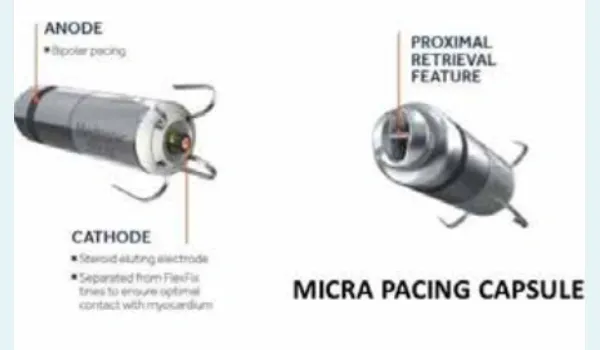
Figure 1: Micra Pacemaker
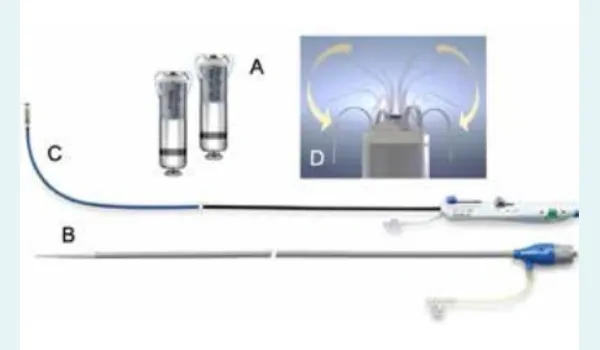
Figure 2: Micra pacemaker and delivery system
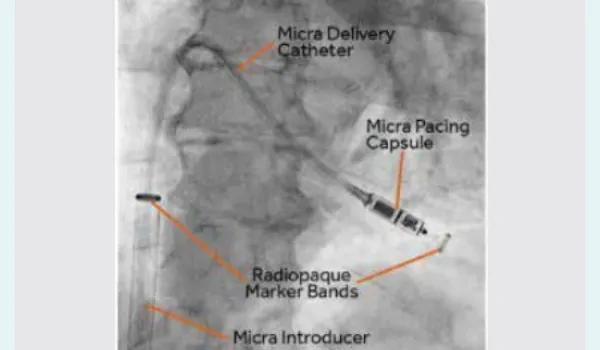
Figure 3: Micra Pacemaker delivery -The procedure is guided by fluoroscopy (an X-ray imaging technique). If the position is suboptimal, both leadless pacemakers are repositionable and retrievable in the short-term using a specific catheter.
Figure 4: Final deployment of AVEIR leadless pacemaker
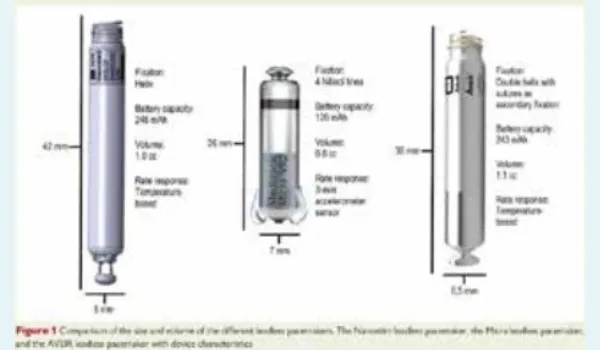
Figure 5: Comparison of the size and volume of the different leadless pacemakers. The Nanostim leadless pacemaker, the Micra leadless pacemaker, and the AVEIR leadless pacemaker with device characteristics6
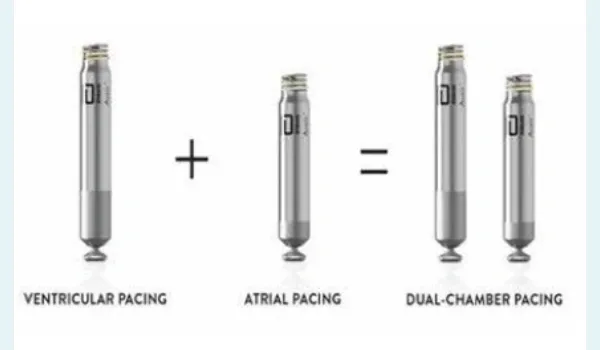
Figure 6: Dual chamber pacing6
LPMs: The past
The first LPM was the Nanostim (St. Jude/Abbott), which was implanted 1,423 times globally between 2012 and 2017.7 It was a single-chamber LPM, able to pace and sense in the ventricle and deliver rate response (VVI[R] mode). Although studies reported a high success rate, serious concerns arose over early battery depletion in 7 of the 1423 implanted devices (0.5%) within 29-37 months post-implantation, leading to its withdrawal and cancellations of future implantations.8
LPMs: The Current Status
The first Micra VR LPM was implanted in 2013. Since then, more than 200,000 devices have been implanted. Compared to Nanostim, the Micra is shorter (25.9 vs. 42 mm), and occupies <2% of the right ventricular (RV) volume. Published studies have shown excellent implantation success and stable electrical parameters with Micra LPM.9,13
LPMs: The Future
Although current LPM use is mostly confined to singlechamber right ventricular pacing, most pacemaker patients require dual-chamber pacing.10 Significant advancements in LPM technology have been observed in recent years. A notable development is the Micra AV, a second-generation device offering AV synchrony via a new pacing algorithm that relies on sensing mechanical atrial contraction. This feature allows the pacemaker to coordinate the timing between the atria and ventricles, providing a more natural heart rhythm for patients with AV block. It suits patients with AV block and intact sinus node function but may be less effective in older adults with frequent sinus node dysfunction.
The development of true dual chamber LPMs (Figure 6) represents a breakthrough. In this approach, two miniaturised pacemakers are implanted, one in the atrium and one in the ventricle, that communicate wirelessly to ensure optimal heart function. This innovation expands the use of LPMs to a broader patient population, including those who require pacing in both heart chambers.
The AVEIR VR (ventricular rate-responsive) and AVEIR AR (atrial rate-responsive) represent further advancements in LPM technology. These are designed for long-term retrieval and extended battery life, making them suitable for even younger populations. It has mapping capabilities prior to fixation, which aid in optimal device placement and reduces the need for repositioning. The AVEIR AR is part of a dualchamber system that allows for atrial and ventricular pacing, providing comprehensive cardiac rhythm management.
Dual Chamber Leadless Pacing
The AVEIR DR dual-chamber LPM by Abbott represents a significant advancement in leadless pacing technology. It consists of two devices implanted percutaneously, one in the right atrium and one in the right ventricle. In the AVEIR DR i2i (implant-to-implant) study, the procedural success rate was 98.3%.11 This system allows for synchronised dual-chamber pacing using proprietary i2i™ communication technology, which transmits high-frequency electrical impulses to relay messages between co-implanted leadless pacemakers via the naturally conductive characteristics of the blood. This ensures continuous AV synchrony, which is crucial for patients with conditions like sick sinus syndrome or AV block. These co-implanted LPMs are fully capable of pacing, just like the traditional dual chamber pacemakers. The system is upgradeable, supporting tailored therapy as patient needs evolve.
Leadless Conduction System Pacing (CSP)
CSP is an evolving technique in which a traditional pacemaker wire is implanted deep into the interventricular septum (wall separating the left and right chambers of the heart). This approach activates the left bundle branch (LBB) area enabling physiological pacing which mimics the heart's natural electrical current. As a result, this pacing approach offers more physiological pacing than standard options. The future of LPMs includes the development of leadless CSP systems. Abbott's investigational AVEIR CSP is designed to deliver pacing to the LBB area, a key part of the heart's electrical conduction system. This approach aims to mimic the heart's natural beat more closely, offering a new treatment option for patients with slow or irregular heart rhythms.
Remote monitoring and programming capabilities are also under investigation, as is the integration of LPMs with other traditional cardiac implantable electronic devices (CIEDS) for dual functioning.
The evolution of LPMs represents a significant leap forward in cardiac care. The seamless integration of CSP procedures with leadless pacemaker technology has the potential to deliver unique benefits over traditional pacemakers. With continuous advancements in technology and research, these devices are set to become even more effective and accessible, offering hope to millions of patients worldwide. As we look to the future, the potential for LPMs to transform the landscape of cardiac pacing is immense.
LPMs and the Subcutaneous Implantable CardioverterDefibrillator (S-ICD)
The S-ICD is an established alternative to the transvenous ICD.12 However, S-ICDs lack pacing for bradycardia or anti tachycardia pacing (ATP). For such patients, requiring both defibrillation and pacing, co-implantation with an LPM offers an extravascular solution. Case reports show that currently available LPMs can be co-implanted with S-ICDs to provide anti-bradycardia pacing. However, potential issues include double counting (leading to inappropriate shocks) and under-sensing of ventricular arrhythmias due to pacing artefacts. Also, no ATP can be provided. A coordinated system with wireless communication between S-ICD and LPM may overcome these potential problems.
Conclusion
Over the past decade, LPM therapy has matured from an experimental to an established treatment option. A substantial body of observational evidence suggests that single-chamber VVI(R) LPMs are associated with fewer infections and complications, compared to transvenous pacemakers, particularly over the long term. While acute perforations may be more frequent and severe, they are often mitigated by operator training and experience. The introduction of leadless VDD(R), and more recently DDD(R) pacing has expanded the indications for LPM therapy to considerably more patients. With promising early data on LBB-area LPM implantation, the future for LPM therapy looks very promising. These advances offer a pathbreaking opportunity to reshape the landscape of cardiac pacing.
Viveka Kumar, Sangeeta Dhir, Mitendra Singh Yadav. Leadless Cardiac Pacing – A Narrative Review. MMJ.
2025, June. Vol 2 (2).
References
- Glikson M, Nielsen JC, Kronborg MB, et al. 2021 ESC guidelines on cardiac pacing and cardiac resynchronization therapy. Eur Heart J. 2021;42: 3427-3520.
- Udo EO, Zuithoff NP, van Hemel NM, et al. Incidence and predictors of short- and longterm complications in pacemaker therapy: the FOLLOWPACE study. Heart Rhythm. 2012;9:728-35.
- Lakkireddy D, Knops R, Atwater B, et al. A worldwide experience of the management of battery failures and chronic device retrieval of the Nanostim leadless pacemaker. Heart Rhythm. 2017;14:1756-63.
- Da Costa A, Axiotis A, Romeyer-Bouchard C. Transcatheter leadless cardiac pacing: the new alternative solution. Int J Cardiol. 2017;227:122-6.
- Baimbetov A , Bizhanov K, Yakupova I, et al. Advantages of leadless pacemakers compared to conventional pacemakers. Eur Heart J. 2023;44(Supplement_1):ehac779-030.
- Talib SS, Hoevenaars CPR, Molitor N, et al. Leadless pacing: a comprehensive review. Eur Heart J. 2025; 00:1-12.
- Panel of the Medical Devices Advisory Committee. Nanostim. TM Leadless Pacemaker System. Executive Summary for the Circulatory System Devices, St. Jude Medical. U.S. Food and Drug administration, 2016.
- Oosterwerff EFJ, Salavati A, Lenssen M, et al. Experience with malfunctioning leadless pacemakers: troubleshooting and management during medium-term follow-up. Heart Rhythm. 2022;19:894–900.
- Ritter P, Duray GZ, Steinwender C, et al. Early performance of a miniaturized leadless cardiac pacemaker: the Micra transcatheter pacing study. Eur Heart J. 2015;36:2510-9.
- Mond HG, Proclemer A. The 11th World Survey of Cardiac Pacing and Implantable Cardioverter Defibrillators: calendar year 2009–a World Society of Arrhythmia’s project. Pacing Clin Electrophysiol. 2011;34:1013-1027.
- Knops RE, Reddy VY, I JE, et al. A dual chamber leadless pacemaker. N Engl J Med. 2023;388:2360-70.
- Fong KY, Ng CJR, Wang Y, et al. Subcutaneous versus transvenous implantable defibrillator therapy: a systematic review and meta-analysis of randomized trials and propensity score-matched studies. J Am Heart Assoc. 2022;11:e024756.
- Kumar V, Kumar V, Agarwal R, et al. Implantation of the Micra transcatheter pacing system: A single center North India experience. Indian Pacing Electrophysiol J. 2021;21:18-24.