 WhatsApp Us (24/7)
 +91 926 888 0303 (24/7)


Abstract:
Total knee arthroplasty (TKA) has undergone significant advancements since its inception in the late 19th century. However, nearly 20% of patients report unsatisfactory outcomes. This review summarises the recent advances and practices aimed at improving the results of primary TKA. Implant designs have evolved to enhance longevity, address diverse patient needs, and align with specific alignment philosophies. Smart sensor implants offer the potential for real-time monitoring of implant function and patient activity levels. Advancements in implant materials focus on enhancing longevity, biocompatibility, and functionality. Multiple alignment philosophies are being adopted to better replicate knee anatomy and kinematics. Robotic-assisted surgery (RAS) has emerged as a promising approach, enhancing precision through a robotic arm after creating a 3D model of the knee joint. Effective perioperative pain management is crucial for promoting early mobilisation and expediting hospital discharge. New patient specific multimodal perioperative pain control techniques, such as targeted surgical local infiltration analgesia, adductor canal blockade, genicular nerve blocks, and the infiltration between the popliteal artery and capsule of the knee (iPACK) block, have shown promise in improving postoperative pain relief and reducing opioid consumption. With these advanced practices, we hope to reduce the unsatisfactory outcomes and improve implant survivorship.
Key words:Knee Arthroplasty, Recent Advances, Implant Design, Material, Philosophies, Robotic, Pain Management.
Introduction
Knee arthroplasty is a surgical treatment offered to patients with knee arthritis who do not respond to conservative therapy. Numerically, it is the most common major surgical procedure in orthopaedic surgery around the world. It includes a variety of surgical procedures ranging from partial knee arthroplasty, primary total knee arthroplasty, complex primary knee arthroplasty, and revision knee arthroplasty. The concept of knee arthroplasty can be traced back to the late 19th century when Themistocles Gluck attempted the first artificial joint replacement using ivory components in 1890.1 The modern era of knee replacement began in the 1950s and 1960s. In 1951, Börje Walldius introduced a hinged prosthesis made of acrylic, which was later replaced with cobalt-chrome in 1958.2 A significant breakthrough came in the 1970s with the introduction of the total condylar knee by John Insall and colleagues.3
The 1980s saw further refinements in implant design and materials. The introduction of modular components allowed for greater flexibility in addressing individual patient needs. Improvements in polyethylene manufacturing processes led to more durable implants, reducing wear and extending implant longevity.
In the 1990s, minimally invasive surgical techniques began to emerge, offering potential benefits such as reduced postoperative pain and faster recovery. This period also saw the development of computer-assisted surgery, which aimed to improve the accuracy of implant positioning.4 The turn of the 21st century brought significant advancements in implant materials and designs. Highly cross-linked polyethylene was introduced to further reduce wear and improve longevity.5 Gender-specific and high-flexion designs were developed to better accommodate anatomical variations and functional demands.6
Recent years have witnessed the rise of personalised implants7 and robotic-assisted surgery (RAS). Advances in perioperative pain management have also played a crucial role in improving outcomes. Enhanced recovery protocols, including multimodal pain management and early mobilisation, have significantly reduced hospital stays and accelerated rehabilitation.
Despite these advancements, challenges remain, and nearly 20% of patients report unsatisfactory outcomes. Issues such as implant loosening, infection, and persistent pain continue to be areas of ongoing research and development. The pursuit of the "forgotten knee" – a replacement that feels and functions like a natural knee–remains a key goal in the field. In this article, we have summarised the recent advances and practices aimed at improving the results of TKA. We have limited our purview to include only primary total knee replacement.
Implant Design
Total knee arthroplasty (TKA) implant designs have evolved significantly over time to improve patient outcomes, enhance implant longevity, and address diverse patient needs while also aligning with specific alignment philosophies. There are several implant designs available in current practice (Table 1) (Figure 1).
In the future, we may have smart sensor implants that will offer significant potential for real-time monitoring of implant function, wear, and patient activity levels. These intelligent devices can provide diagnostic capabilities along with therapeutic benefits.
Intraoperatively, smart sensor-assisted TKA can objectively assess ligament and soft tissue balancing while maintaining proper alignment to achieve desired kinematic targets. Postimplantation, these sensors can monitor implant performance under natural conditions and track the patient's clinical recovery during rehabilitation. This real-time data could help detect early signs of complications like polyethylene wear, which is a major cause of TKA failure.8
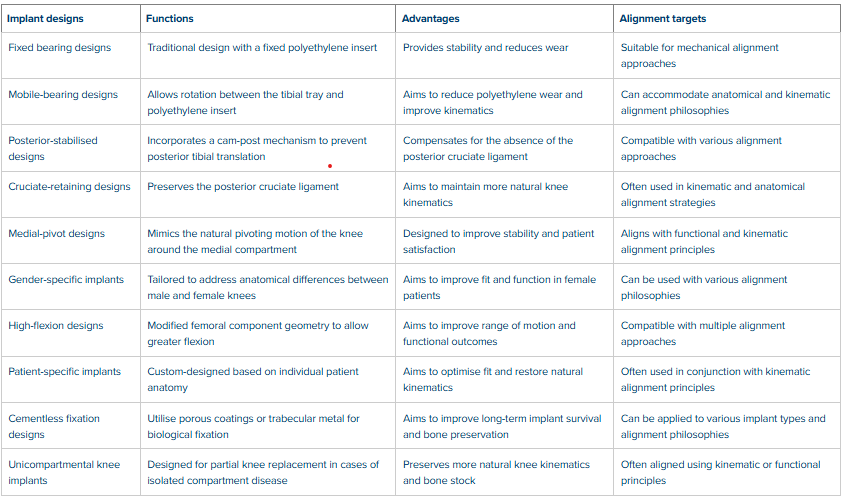
Table 1: Implant designs in current practice.
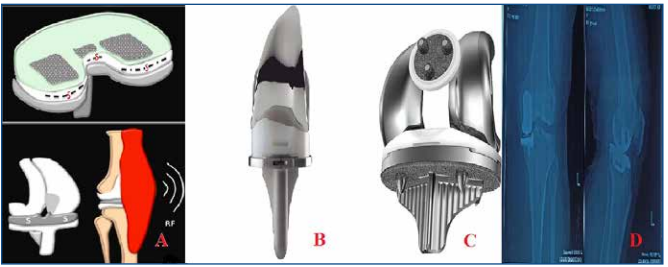
Figure 1: A- Smart knee implant, B- Medial pivot knee, C- Cement-less knee, D- Unicondylar knee.
Implant Material
Recent advancements in implant materials for TKR have focused on enhancing longevity, biocompatibility, and functionality. Several key developments have emerged (Table 2) (Figure 2)
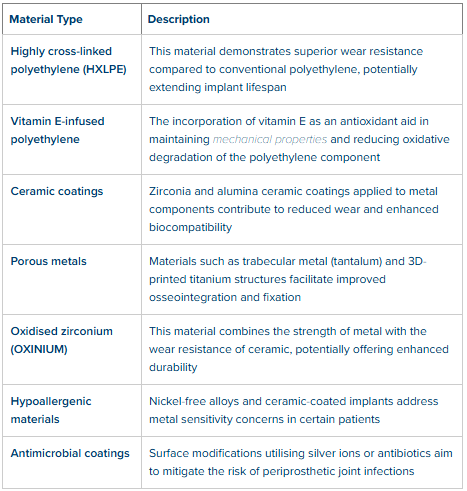
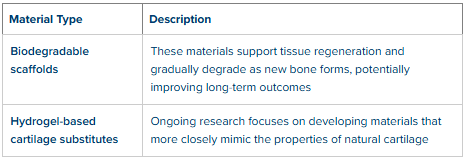
Table 2: Implant materials.
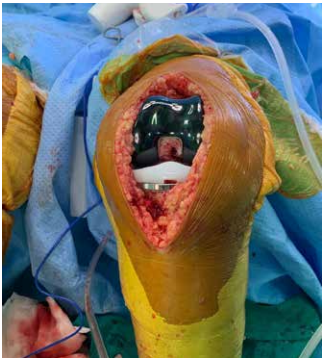
Figure 2: Oxinium knee.
Alignment Philosophy
The importance of coronal alignment in TKA has become increasingly recognised as a crucial factor in enhancing clinical outcomes. In response to patient dissatisfaction and the perception of an "unnatural knee" following TKA, various
alignment strategies and philosophies have been developed to better replicate knee anatomy and kinematics. Currently, several principles and surgical techniques have been described. (Table 3)
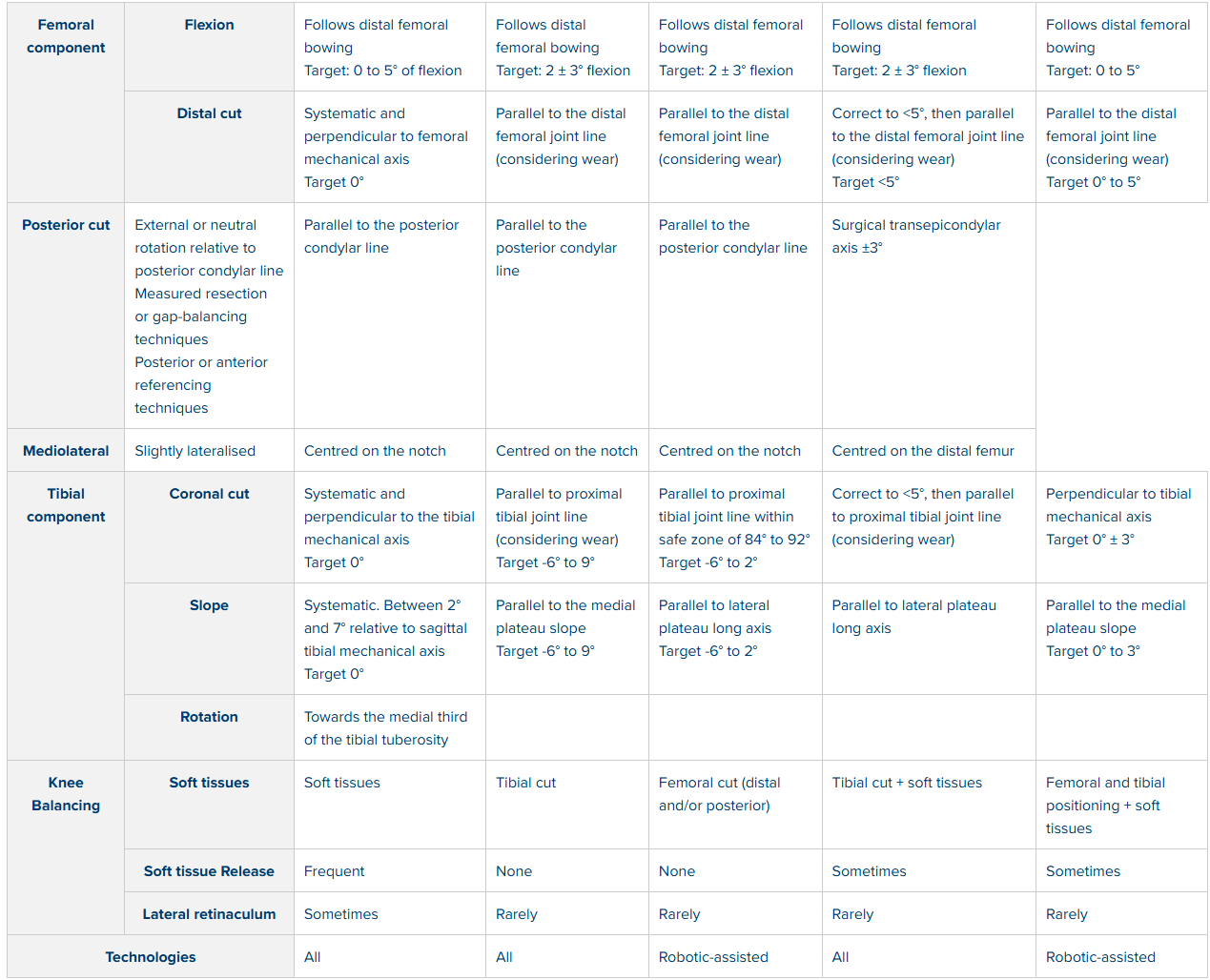
Table 3: Alignment philosophies.
Robotic-Assisted Surgery
Conventional jig-based TKA is based on preoperative radiographs, intraoperative anatomical landmarks, and manually positioned alignments jigs to guide bone resections and implant positioning. Conventional TKA poses a risk of poor reproducibility, soft tissue iatrogenic injuries and limited intraoperative data on gap measurements and ligament tensioning. Computer-assisted surgery (CAS) uses a computer system to obtain live on-screen information about patient anatomy and knee kinematics during surgery (Figure 3). CAS provides the surgeon with patient-specific anatomical data and indications for bone resections and optimal implant positioning, but the computer system does not actively intervene in the operation. RAS intervenes in surgery, improving accuracy through a robotic arm after creating a 3D model of the knee joint based on the patient’s anatomical landmarks. A brief summary of robotic systems in current practice is provided below (Table 4) (Figure 4).
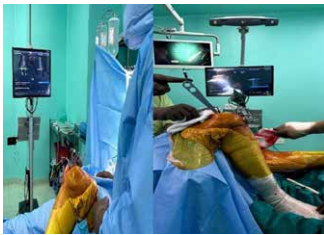
Figure 3: Computer navigation assisted total knee replacement.
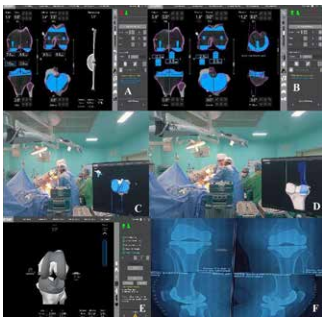
Figure 4: Robotic knee replacement A- Implant planning, B- Ligament balancing, C- Execution by robotic arm (tibia), D- Femur, E- Trailing with assessment of laxity, F- Final X ray.
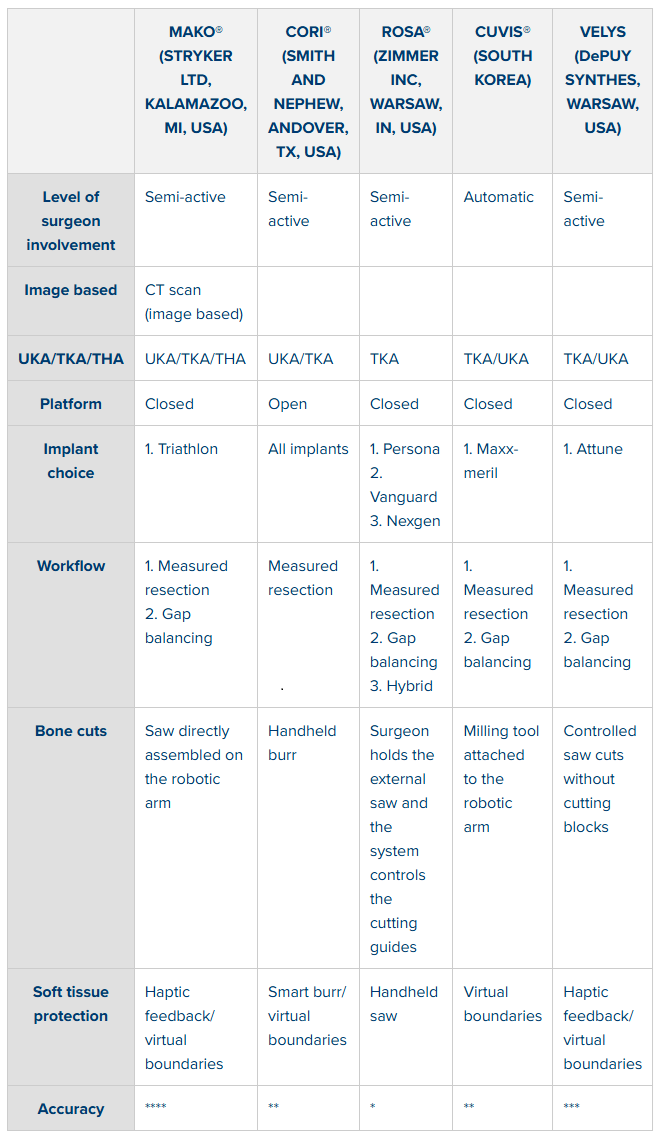
Table 4: Robots in current practice.
Abbreviations: UKA: unicompartmental knee arthroplasty; THA: total hip arthroplasty; TKA: total knee arthroplasty
Perioperative Pain Management
Severe postoperative pain is a common consequence of TKA. Effective pain management is crucial for promoting early mobilisation and expediting hospital discharge following this procedure. Recent advancements in motor-sparing regional anaesthesia techniques have enhanced recovery after TKA. Several promising approaches have emerged to improve postoperative pain relief, including targeted surgical local infiltration analgesia, adductor canal blockade, genicular nerve blocks, and the iPACK block. These motor-sparing regional anaesthesia methods contribute to a multimodal analgesic strategy, which aims to decrease opioid consumption and enhance functional recovery. Advent of liposomal bupivacaine as local anaesthetic agent gives analgesia up to 72 hours in single shot nerve block techniques (Table 5) (Figure 5).
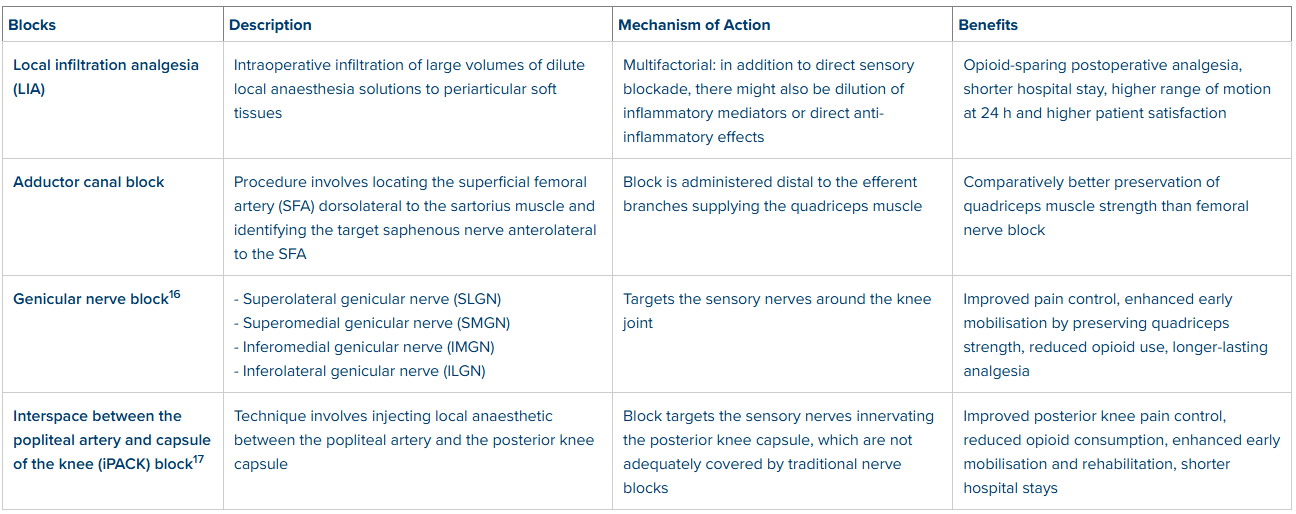
Table 5: Perioperative pain management.
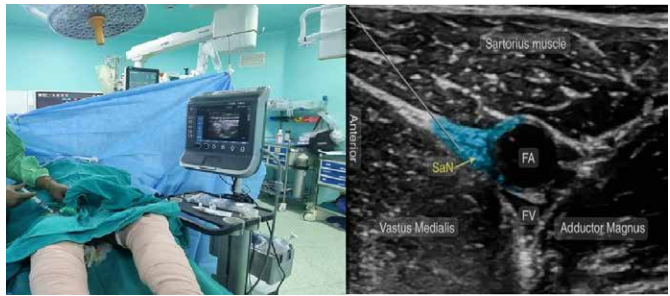
Figure 5: Adductor canal block.
Acknowledgement: Nil
Conflict of interest: No conflict of interest
Conclusion
Knee arthroplasty continues to evolve, with efforts to improve postoperative function and increase implant survivorship. Advanced techniques and materials offer promising benefits; however, but they must demonstrate superiority over current practices and prove value for money before being widely adopted for patient care.
Ramneek Mahajan, Keshave Singh, Akshay Kumar, Ashutosh Karn, Manish Jagia, Puneet. Recent Advances
in Knee Arthroplasty: A Narrative Review. MMJ. 2025, March. Vol 1 (5).
DOI: XXXX
References
- Bankes MJK, Emery RJH. Pioneers of shoulder replacement: Themistocles Gluck and Jules Emile Péan. J Shoulder Elbow Surg. 1995;4(4):259-62.
- Phillips H, Taylor JG. The Walldius hinge arthroplasty. J Bone Joint Surg Br. 1975;57(2):59-62.
- Hvid I, Nielsen S. Total condylar knee arthroplasty. Prosthetic component positioning and radiolucent lines. Acta Orthop Scand. 1984;55(2):160-5.
- Hodrick JT, Hofmann AA, Dahl B, et al. Highly Crosslinked Polyethylene is Safe for Use in Total Knee Arthroplasty. Clin Orthop Relat Res. 2008;466(11):2806-12.
- Bae DK, Song SJ. Computer Assisted Navigation in Knee Arthroplasty. Clinics in Orthopedic Surgery. 2011;3(4):259-267.
- Clarke HD, Hentz JG. Restoration of Femoral Anatomy in TKA With Unisex and Gender-specific Components. Clin Orthop Relat Res. 2008;466(11):2711–6.
- Chen JY, Chin PL, Tay DKJ, et al. Functional Outcome and Quality of Life after Patient-Specific Instrumentation in Total Knee Arthroplasty. J Arthroplasty. 2015;30(10):1724-8.
- Iyengar KP, Gowers BTV, Jain VK, et al. Smart sensor implant technology in total knee arthroplasty. J Clin Orthop Trauma. 2021;22:101605.
- Ramavath D, Yeole SN, Kode JP, et al. Development of patient-specific 3D printed implants for total knee arthroplasty. Explor Med. 2023;4:1033–47.
- Spece H, Yarbrough RV, Kurtz SM. A Review of Early In Vivo Performance of Antioxidant Stabilized Polyethylene for Total Knee Arthroplasty. J Arthroplasty. 2023;38(9).
- Insall JN, Binazzi R, Soudry M, et al. Total knee arthroplasty. Clin Orthop Relat Res. 1985;192:13-22.
- Hungerford DS, Krackow KA. Total joint arthroplasty of the knee. Clin Orthop Relat Res. 1985;192:23-33.
- Howell SM, Roth JD, Hull ML. Kinematic Alignment in Total Knee Arthroplasty. Definition, History, Principle, Surgical Technique, and Results of an Alignment Option for TKA. Arthropaedia. 2014;1:44-53.
- Winnock de Grave P, Kellens J, Luyckx T, et al. Inverse Kinematic Alignment for Total Knee Arthroplasty. Orthop Traumatol Surg Res. 2022;108(5):103305.
- Almaawi AM, Hutt JRB, Masse V, et al. The impact of mechanical and restricted kinematic alignment on knee anatomy in total knee arthroplasty. J Arthroplasty. 2017;32(7):2133-2140.
- Sahoo RK, Krishna C, Kumar M, et al. Genicular nerve block for postoperative pain relief after total knee replacement. Saudi J Anaesth. 2020;14(2):235-237.
- Kandarian B, Indelli PF, Sinha S, et al. Implementation of the IPACK (Infiltration between the Popliteal Artery and Capsule of the Knee) block into a multimodal analgesic pathway for total knee replacement.