 WhatsApp Us (24/7)
 +91 926 888 0303 (24/7)


Abstract:
Arthrodesis and arthroplasty represent two contrasting surgical philosophies in the management of joint pathology, focusing respectively on the elimination and preservation of joint motion. This review aimed to examine the historical evolution, current indications, and comparative roles of these procedures across major joints through a narrative analysis of historical developments, surgical principles, and contemporary clinical trends. Findings indicate that arthroplasty has emerged as the preferred treatment for large joints such as the hip, knee, and shoulder because of its favourable functional outcomes and restoration of mobility. In contrast, arthrodesis continues to play a significant role in the management of the spine, ankle, wrist, and small joints, especially in resource-constrained settings where durability and cost considerations are important. Overall, the selection between arthrodesis and arthroplasty is guided by joint biomechanics, patient-specific factors, and available healthcare resources, highlighting that these procedures function as complementary rather than competing surgical strategies.
Key words: Arthrodesis, Arthroplasty, Joint Fusion, Joint Replacement, Orthopaedics.
Introduction
Surgery to permanently fuse the bones of a joint is called arthrodesis. The word comes from the Greek word “arthron”, meaning “joint”, and “desis”, meaning “binding” or “tying”. A less commonly used etymology to describe the same procedure is artificial ankylosis or syndesis. Arthrodesis is primarily done to relieve pain and correct deformity.
The common sites of arthrodesis are the spine, hand, ankle, and foot. Arthrodesis was once commonly performed for painful hips or knees, but the advent and success of arthroplasty for these joints have rendered arthrodesis a salvage procedure.
Arthroplasty is the term for the removal of a diseased or injured joint and its replacement with an artificial joint. The Greek word “arthros” means "joint," and “plassein” means "to form" or "to mould". Arthroplasty is performed when non-surgical treatments have proven futile in treating osteoarthritis, rheumatoid arthritis, avascular necrosis, or severe joint fractures. The common sites for arthroplasty are the hip, knee, and shoulder.
Historical Aspects
Arthrodesis
In 1878, Eduard Albert in Vienna coined the term arthrodesis when he performed the fusion of both knees and ankles in a 14-year-old child who had severe palsy of the lower extremities.1,2 Albert was a Czech surgeon who held the chair of surgery in Vienna.
Arthrodesis of the hip was attempted in 1888 by Heuster and Lampugnani.3 The earlier fusers of the tarsus, after the publication of Albert’s paper, were Cuthbert Hilton GoldingBird of Guy’s Hospital in London and Alexander Ogston of Aberdeen, who in 1884 described talonavicular fusion in children with severely pronated feet. In Philadelphia, Gwilym G. Davis popularised subtalar arthrodesis in 1913. It remained a commonly performed procedure for a decade, and seriously competed with Royal Whitman’s astragalectomy, done for paralytic equinovarus deformity.4 Edwin W. Ryerson, a surgeon in Chicago, coined the term "triple arthrodesis", an operation still performed today.4 This is the fusion of three joints: the subtalar, talonavicular, and the calcaneocuboid joints.
Frederick Albee, at the New Y ork Postgraduate Medical School Clinic, perfected spinal arthrodesis using bone grafts from the tibia in children with tuberculosis (TB) of the spine. 5 Interestingly, he had learnt tree grafting as a youngster working on a farm, he applied the same principles to attain spine fusions. Another American, Russell Hibbs, at the New Y ork Orthopaedic Hospital, performed spinal fusion using the spinous processes of vertebrae.6 These were divided at their base and used as autografts to obtain interlaminar fusion. These fusion techniques were used in treating spinal TB.
In 1949, DJ Glissan from New Zealand laid down the four principles specifically for ankle arthrodesis. These are cited as fundamental to performing the procedure in any part of the body. They are the complete removal of all cartilage and fibrous tissue, accurate and close fitting of fusion surfaces, optimal joint positioning, and maintenance of bone apposition undisturbed until fusion is complete.7 John Charnley, in 1951, showed that sustained compression in joint fusion operations was the essential biological mechanism for the knee, ankle, and shoulder.8 In a remarkable intellectual journey, Charnley moved from fusion surgery, abolishing all movement, to arthroplasty, permitting full movement.
Robert Danis was a Belgian surgeon who used the principles of arthrodesis in fracture treatment. Maurice Muller was impressed with his work and assembled a study group, leading to the Arbeitsgemeinschaft für Osteosynthesefragen (AO) group. They advocated the same principles for arthrodesis as they did for fracture treatment. These are rigid stabilisation, compression, and early mobilisation. 9 Essentially, they transformed Charnley’s principles into a disciplined teaching system.
They provided the hardware for arthrodesis, including lag screws, cancellous screws, and compression plates.
Arthroplasty
Though the French surgeon, Jules-Emile Pean, performed the first shoulder replacement on a baker, Jules Pedoux, in 1893,10 ancient Greek mythology credits the myth of Pelops’ ivory shoulder as the first shoulder replacement.11 Arthroplasty evolved to treat joint destruction, mainly due to TB. Ivory was used to create a prosthesis by Themistocles Gluck, who performed the first ivory knee replacement on 20th May 1890; he followed this up with a total wrist, replacement in another patient three weeks later. Gluck realised that his prosthesis needed sound fixation in bone. He experimented with copper, amalgam, plaster of Paris, and stone putty — a resin mixed with pumice stone or gypsum. He favoured osseointegration, or bone ingrowth into the implant to secure fixation. He predated the work of John Charnley, and even today, cement versus cementless fixation stokes controversy.12 Infection, however, remained a major obstacle. Marius Smith-Petersen, a pioneer in the early days of hip arthroplasty, worked on mould arthroplasty (he is known for a surgical approach to the hip, spinal osteotomy, and nailing of hip fractures), 13 using glass and Vitallium cups. Various materials have been used for interpositional arthroplasty, such as fascia lata and pig bladder. In 1940, Austin Moore replaced the proximal end of the femur with a metallic prosthesis shaped in the form of the proximal femur.14 Eighty-five years later, it is still in use in many parts of the world, including India, for older and less active patients with femoral neck fractures. In the 1960s, Sir John Charnley perfected ‘low-friction arthroplasty’ for the treatment of end-stage, symptomatic osteoarthritis of the hip. Essentially, the femoral head and femoral neck are excised. The acetabulum is enlarged, and an acetabular cup is inserted. The femoral component is cemented in place. Total hip replacement is effective in alleviating pain, restoring mobility, and is a cost-effective option for hip arthritis. It is arguably the most successful of all surgical inventions.15 In 1974, John Insall developed the total condylar knee, and modern knee replacements are based on his concepts. He is known as the Father of Knee Replacement.16 Charles Neer reported a series of eight shoulder hemiarthroplasties, with encouraging results. This developed into the Neer 1 prosthesis, made of Vitallium. He used it to treat fracture-dislocations, avascular necrosis, and osteoarthritis.17 He emphasised the importance of tuberosity fixation and healing. The Neer 2 prosthesis was a monoblock stem, and by the 1980s, modularity was introduced, with a stem and head of several sizes. Reverse total shoulder arthroplasty, again introduced by Neer, reversed the normal anatomy by placing the socket in the proximal humerus and the prosthetic ball in the glenoid of the scapula. This allows treatment of glenohumeral arthritis and rotator cuff deficiency. Paul Grammont, a French surgeon, further refined the procedure.
The trends today are towards cementless fixation using porous coatings, allowing bone to grow into the implant, ceramic acetabular components, and highly cross-linked polyethylene to reduce wear. Recent advances include robotic-assisted surgery, computer navigation, and threedimensional (3D) printing to produce patient-specific implants. These refinements improve the life of the implant.
Fusion is performed mainly in the spine, ankle, wrist, foot, hand, and smaller joints. It is a salvage procedure for failed arthroplasty in the knee and hip joints.
The Paradox of Motion
The goal of surgery is to restore meaningful function. Joints are designed by nature to permit movement; copying nature’s stance, prostheses have been designed with considerable ingenuity to permit this. The success of an operation is judged by motion preservation using these implants. Admirably, favourable outcomes have been achieved in the hip and knee joints. Paradoxically enough, the success of arthrodesis in the joints of the spine, ankle, and wrist challenges the assumption that movement is the only sine qua non as the barometer of success Figure 1 shows the outcomes of arthrodesis and arthroplasty.
Arthrodesis, or the renunciation of movement, is the equivalent of surgical austerity — it is a procedure that removes painful motion and thereby confers stability and restores function.
The spine
The spine is a surgical outlier. The indications for spinal fusion are clear: degenerative disc disease, spondylolisthesis, spinal stenosis, fractures, and scoliosis.
The problem in the spine is not the absence of motion, but that motion is painful, or is excessive, as in degenerative disc disease. Movement in the affected region of the spine is clearly unhelpful. Pain in degenerative spine disease is frequently attributed not to immobility, but to abnormal or excessive motion. Spinal fusion, therefore, aims to eliminate pathological micromotion, restore the overall alignment, particularly sagittal balance, and protect the neural elements. It is somewhat of a paradox that the fusion of the painful part makes the spine overall more mobile. In carefully selected patients, the results of well-performed surgery are excellent. Figure 2 shows the fusion between L5 and S1 vertebrae in the spine.
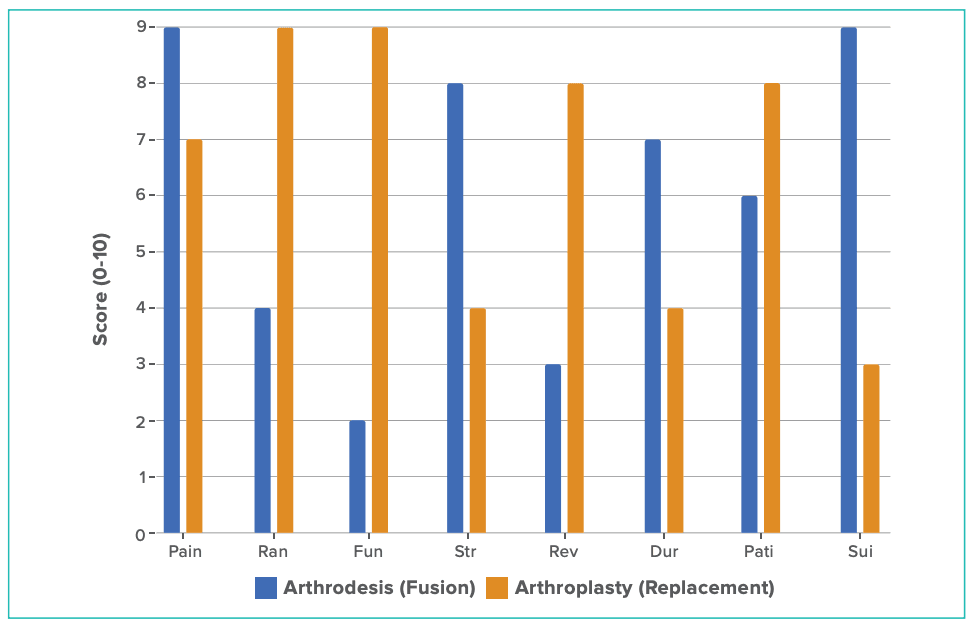
Figure 1: Arthrodesis vs arthroplasty — a comparison of clinical parameters. The Y-axis measures the relative advantage score on a scale of 0–10, where 0 is the worst possible outcome, and 10 is the best possible outcome. A high bar means the best possible outcome. The X-axis measures various parameters. The measured parameters are Pai (pain); Ran (range of motion), or the range of motion preserved/restored in the joint after surgery; Fun (functional mobility), or day-to-day mobility, such as walking and climbing stairs; Str (structural stability), or the mechanical reliability of the construct under load and over time; Rev (revision flexibility), or the ease with which the procedure can be revised if needed; Dur (duration/ longevity), or the expected lifespan of the surgical procedure; Pati (patient satisfaction) with the procedure; and Sui (Suitability) for high-demand, young patients.
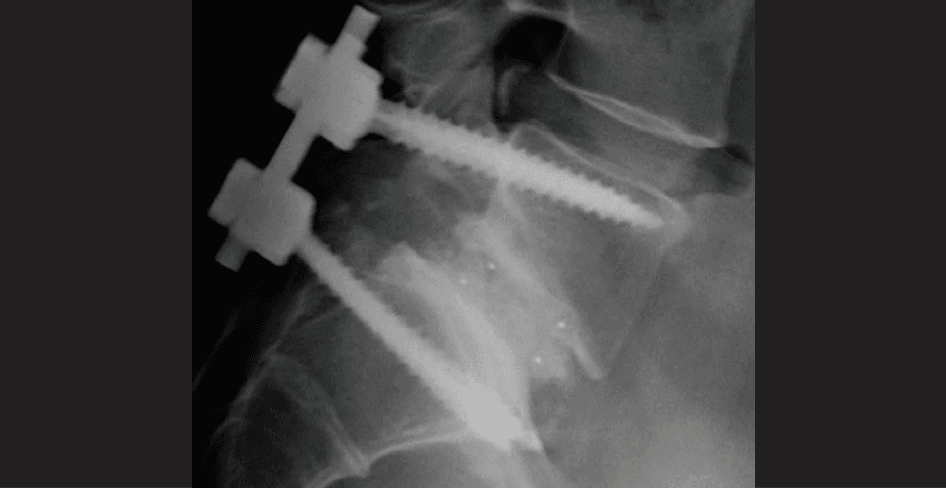
Figure 2: L5–S1 fusion of the spine
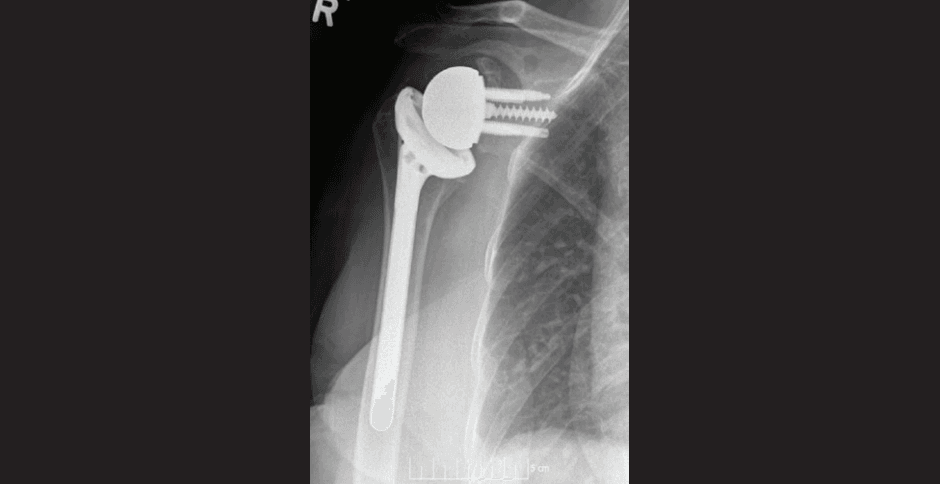
Figure 2: Reverse shoulder replacement
Spinal fusion numbers have increased from 40,000 to a million per year, representing an enormous increase.18 No global registry exists to determine the true incidence of spinal fusion. It is estimated that in the United States, approximately 4,00,000–6,00,000 spines are fused annually. Comparative trends are seen in Europe and Asia as well.
Fusion surgery has its limitations as well. It is not effective in chronic back pain of no identifiable cause.19,20 Here, a structured rehabilitation programme is more effective. Correction of vitamin D3 deficiency, back and abdominal strengthening exercises are useful.
Pain that returns after surgery may be due to a failed fusion, causing instability, or due to adjacent segment degeneration. This is a common complication where discs above and below a fusion become stressed and degenerate.
Is artificial disc replacement an alternative to fusion? It replaces the damaged disc with a prosthesis to restore mobility and height; it is used in the cervical and lumbar spine.22 It is restricted to candidates who have degeneration at one or two levels, and there should not be arthritis in the facet joints, otherwise persistent pain may remain unrelieved. The recipient’s bones should be robust without osteoporosis. This prevents the implant from sinking into the bone. It remains a technically demanding procedure.
Endoscopic spine surgery is an elegant alternative for treating herniated discs or spinal stenosis. When performed correctly, it obviates many of the problems associated with spinal fusion, without causing any softtissue damage.
Research is ongoing into biological solutions. Scientists aim to heal the spine using bioactive materials and by using stem cells.
The ankle
The ankle is a terminal load-bearing joint. Endstage arthritis due to trauma or disease is frequently encountered in the outpatient department (OPD). The preferred procedure is ankle arthrodesis. This is because it is widely available, Indian surgeons are familiar with it, and above all, it remains cost-effective.
Total ankle replacement (TAR) is emerging as an alternative to ankle arthrodesis. It maintains movement and relieves pain. Arthrodesis alone removes pain, but at the expense of movement. TAR is a demanding procedure because of the anatomy of the ankle. 23 The ankle joint is a highly constrained load-bearing joint, subject to repetitive load-bearing forces. The tolerances are narrow, in contrast to the hip, which is a ball-andsocket joint and more forgiving. The knee distributes the load over a broader surface. However, ankle arthroplasty has to maintain alignment, withstand loads, preserve motion, and avoid loosening.
The number of dedicated foot and ankle specialists is limited to large tertiary centres. There are sparse TAR case volumes. The estimated ratio of arthrodesis to arthroplasty is 10–20:1, and this may be even higher. In the United States and Europe, the ratio of arthrodesis to arthroplasty is 1.5–5:1.
One factor may be the high cost of TAR, which is 1.5–4.5 lakh. Fusion is substantially cheaper. Arthroplasty is restricted by implant availability, lack of specialised centres, follow-up requirements, and the lack of revision infrastructure. It is confined to tertiary centres in the metropolitan cities and to surgeons with international training.
In India, ankle arthrodesis predominates. Arthroplasty is not the best choice for younger and more active patients.
The wrist
The wrist is a multiaxial joint. Despite its important role in hand function and grip strength, arthritis of smaller joints, including the wrist, often goes unaddressed. They are considered part of the “other osteoarthritis” category in epidemiology. 24 In the general population, wrist arthritis affects 1%–2% of adults. Common causes are osteoarthritis due to wear and tear, rheumatoid arthritis, posttraumatic arthritis, and tubercular arthritis.
Wrist arthrodesis remains the procedure of choice in arthritis. It has predictable outcomes — relief of pain, improved grip strength; the trade-off is complete loss of wrist motion. Patients compensate using forearm pronation–supination and by finger–elbow movements. Most daily activities, such as eating, writing, and lifting light objects, are possible. Heavy manual work is possible because the pain has gone. Fine tasks needing wrist flexion and extension are not possible. Other side effects of arthrodesis may be non-union, hardware irritation, and adjacent joint stress.
Total wrist arthroplasty, in contrast to wrist arthrodesis, is a relatively rare procedure. It accounts for less than 1% of all joint replacements, and its use is limited by implant longevity and the biomechanical complexity of the wrist. The wrist has multiple small joints and intricate motion.
These factors make it difficult to replicate with a prosthesis.
Wrist arthroplasty is valuable in patients with inflammatory arthritis.25 Preservation of motion is desirable. Even so, concerns regarding the longevity, loosening, limited availability of the implant, surgical expertise, and the need for revision in the future are limiting factors.
In the Indian subcontinent, data are sparse, but arthrodesis is the predominant procedure. Arthroplasty remains a rare, niche, and tertiary-centre procedure. The reasons mirror ankle arthroplasty — cost constraints, implant availability, and surgeon familiarity.
The shoulder
The shoulder or the glenohumeral joint is a spheroidal ball and socket joint, where the head of the humerus articulates with the glenoid fossa of the scapula. It has the greatest range of movement of any joint in the human body. Stability is low compared to mobility. It relies heavily on soft tissues for stability — the glenoid labrum, capsule, and the rotator cuff. The shoulder has a built-in advantage — it is not a weight-bearing joint, unlike the hip and knee.
Shoulder arthroplasty is indicated in painful conditions such as osteoarthritis, rheumatoid arthritis, irreparable rotator cuff tears, avascular necrosis of the humeral head, and complex fractures.26 Anatomic shoulder replacement is used when the rotator cuff is intact. It has been largely superseded by reverse shoulder arthroplasty, particularly when the rotator cuff is deficient 27 or in glenohumeral arthritis. Hemiarthroplasty has limited indications and may be of value in elderly patients with painful or grossly comminuted humeral head and neck fractures as a salvage operation.
Arthroplasty is not preferred when there is an irreparable nerve injury, such as an upper brachial plexus injury, resulting in a flail shoulder. 28 It is an option in failed arthroplasty and chronic infection. The fusion is performed in 30° of flexion, 30° of abduction, and 30° of internal rotation. The aim is to produce a stable, pain-free shoulder; movements are provided by the scapula moving on the thorax. This enables the hand to reach the mouth and the head, perform basic hand hygiene, and use the hand in front of the body.
Shoulder arthroplasty is preferred because it provides effective pain relief and preserves the range of motion — an essential function in a highly mobile, non-weightbearing joint. Figure 3 shows reverse shoulder arthroplasty performed in the right shoulder.
Foot, hand, and smaller Joints
Arthrodesis remains the procedure of choice, and fusion produces superior outcomes as compared with arthroplasty.
Hip and knee fusion
Replacement arthroplasty is preferred over fusion; the latter is a salvage procedure for failed arthroplasty or infection.
Arthrodesis Overall
Precise figures for fusion surgery overall in the entire human body are not available. However, several points are clear. Spinal fusion or arthrodesis, accounts for the vast majority of fusions done worldwide. Ankle arthrodesis, or tibiotalar fusion, is commonly used to treat ankle arthritis. Subtalar arthrodesis is combined with talonavicular and calcaneocuboid arthrodesis to treat severe foot arthritis, particularly when the cartilage is worn away, and the bones are painfully grinding against each other. Ankle arthroplasty remains an evolving procedure. It works well in older patients with a low-demand lifestyle, and patient selection is crucial. The wrist joint is routinely fused for severe rheumatoid or post-traumatic arthritis. The first metatarsophalangeal joint is fused if painful arthritis develops. Knee fusion is a rare procedure due to the success of knee arthroplasty. It is an option for painful failed arthroplasty.
Conclusion
Arthrodesis and arthroplasty remain complementary surgical strategies rather than competing doctrines. The choice between them depends on the joint involved, the underlying pathology, patient age and functional demands, bone quality, and available resources. Arthroplasty is generally favoured for large, load-bearing joints where motion preservation is essential, while arthrodesis continues to provide durable pain relief and stability in smaller joints and selected salvage situations. With continued advances in implants, fixation methods, navigation, and biologic augmentation, both procedures will continue to play important roles in restoring function and improving quality of life.
Harinder Nath Bajaj, Sunil Katoch, Sameer Anand. Arthrodesis or Arthroplasty: Where Do We Stand? MMJ. 2026, June. Vol 3 (2).
DOI: XXXX-XXXX
References
- Zwipp H, Rammelt S, Endres T, et al. High union rates and function scores at midterm follow-up with ankle arthrodesis using a four screw technique. Clin Orthop Relat Res. 2009;484(4):958–68.
- Bick EM. Classics of Orthopaedics. Philadelphia: J.B. Lippincott Co.; 1976. p. 52–4.
- Bardakos NV, Villar RN. History and evolution of hip surgery. In: Sekiya JN, Safran MR, editors. Techniques in Hip Arthroscopy and Joint Preservation Surgery. Philadelphia: Elsevier; 2011. p. 2–8.
- Ryerson EW. Arthrodesing operations on the feet. J Bone Joint Surg. 1923;5:453–71.
- Albee FH. Transplantation of a portion of the tibia into the spine for Pott’s disease. JAMA. 1911;57:855.
- Hibbs RA. An operation for progressive spinal deformities. N Y Med J. 1911;93:1013–6.
- Glissan DJ. The indications for inducing fusion at the ankle joint by operation: with description of two successful techniques. Aust N Z J Surg. 1949;19(1):64–71.
- Charnley J. Compression arthrodesis of the ankle and shoulder. J Bone Joint Surg Br. 1951;33-B(2):180–91.
- Muller ME, Allgower M, Schneider R, et al. Manual of Internal Fixation: Techniques Recommended by the AO-ASIF Group. 3rd Edition. Berlin: Springer-Verlag; 1991. ISBN: 978-3-540-52523-3.
- Hawk AJ. The case of Jules Pedoux. Clin Orthop Relat Res. 2015;474(2):302–3.
- Nomikos NN, Yiannakopoulos CK. The first shoulder replacement in ancient Greek mythology: the story of Pelops, King of Elis. Orthop Traumatol Surg Res. 2019;105(5):801–3.
- Eyenon-Lewis NJ, Ferry D, Pearse MF. Themistocles Gluck: an unrecognised genius. BMJ. 1992;305:1534–6.
- Hernigou P. Smith-Petersen and the early development of hip arthroplasty. Int Orthop. 2014;38(1):193–8.
- Hawk AJ. Artifacts: Austin Moore’s hip. Clin Orthop Relat Res. 2023;481(5):870–1.
- Charnley J. Low-Friction Arthroplasty of the Hip: Theory and Practice. Berlin, Heidelberg: Springer-Verlag; 1979.
- Insall J, Scott WN, Ranawat CS. The total condylar knee prosthesis. A report of two hundred and twenty cases. J Bone Joint Surg Am. 1979;61-A:173–80.
- Neer CS, Brown TH Jr, McLaughlin HL. Fracture of the neck of the humerus with dislocation of the head fragment. Am J Surg. 1953;85(3):252–8.
- Ponkilainen VT, Huttunen TT, Neva MH, et al. National trends in lumbar spine decompression and fusion surgery in Finland, 1997–2018. Acta Orthop. 2021;92(2):199–203.
- Fritzell P, Hägg O, Wessberg P, et al. Swedish Lumbar Spine Study Group. Chronic low back pain and fusion: a randomized controlled trial. Spine. 2001;26(23):2521–32.
- Fairbank J, Frost H, Wilson-MacDonald J, et al. Randomised controlled trial to compare surgical stabilisation with intensive rehabilitation for chronic low back pain. BMJ. 2005;330(7502):1233–6.
- Harrop JS, Youssef JA, Maltenfort M, et al. Lumbar adjacent segment degeneration and disease after arthrodesis. Spine. 2008;33(15):1701–7.
- Rao MJ, Cao SS. Artificial total disc replacement versus fusion for lumbar degenerative disease. J Orthop Surg Res. 2014;9:82–90.
- Haddad SL, Coetzee JC, Estok R, et al. Intermediate and long-term outcomes of total ankle arthroplasty and ankle arthrodesis: a systematic review of the literature. J Bone Joint Surg Am. 2007;89(9):1899–905.
- Singh A, Das S, Chopra A, et al. Burden of osteoarthritis in India and its states, 1990–2019: findings from the Global Burden of Disease Study 2019. Osteoarthritis Cartilage. 2022;30(8):1070–8.
- Cavaliere CM, Chung KC. A systematic review of total wrist arthroplasty compared with total wrist arthrodesis for rheumatoid arthritis. J Hand Surg Am. 2008;33(10):1740–7.
- Neer CS. Articular replacement for the humeral head. J Bone Joint Surg Am. 1955;37(2):215–28.
- Walch G, Boileau P. Lateralization and distalization of the center of rotation in reverse shoulder arthroplasty. J Shoulder Elbow Surg. 2011;20(3):480–6.
- Cho AB, Choi HJ, Ferreira CHV, et al. Shoulder arthrodesis for traumatic brachial plexus injuries: functional outcomes and complications. HAND. 2023;18(1 Suppl):6S–13S.