 WhatsApp Us (24/7)
 +91 926 888 0303 (24/7)


Abstract:
Acute worsening of bronchiectasis may lead to critical ventilatory failure, particularly in patients with chronic carbon dioxide (CO2) retention. Markedly elevated partial pressure of carbon dioxide in arterial blood (PaCO2) levels above 150 mmHg are uncommon and potentially fatal. We describe a 71-year-old male with established bronchiectasis who developed profound acute-on-chronic hypercapnic respiratory failure, with PaCO2 peaking at 156 mmHg. Prompt initiation of non-invasive ventilatory support, targeted oxygen therapy, antimicrobial treatment, and airway clearance measures resulted in clinical stabilisation. This case emphasises the reversibility of even extreme hypercapnia when managed early and appropriately.
Key words: Bronchiectasis, Acute Exacerbation, Hypercapnia, Type II Respiratory Failure, Non-Invasive Ventilation.
Introduction
Bronchiectasis is a chronic and progressive airway disorder characterised by irreversible bronchial dilatation caused by recurrent airway inflammation and infection. The disease is associated with impaired mucociliary clearance, chronic sputum production, repeated pulmonary infections, and progressive airflow limitation. 1 Acute infective exacerbations are major contributors to morbidity and mortality, frequently resulting in hospitalisation and respiratory compromise.
In advanced bronchiectasis, chronic hypoventilation and ventilation–perfusion mismatch may culminate in hypercapnic (Type II) respiratory failure. Although moderate carbon dioxide (CO 2) retention is commonly observed in chronic respiratory disorders, extremely elevated partial pressure of carbon dioxide in arterial blood (PaCO 2) levels above 150 mmHg are rarely documented in the literature and may lead to altered sensorium, cardiovascular instability, and respiratory arrest. 2
Non-invasive ventilation (NIV) has become an established therapeutic intervention for acute hypercapnic respiratory failure by improving alveolar ventilation, reducing the work of breathing, and decreasing the requirement for invasive mechanical ventilation. 3 We present a case of severe acute-on-chronic hypercapnic respiratory failure in a patient with long-standing bronchiectasis, successfully managed with early NIV and supportive care.
Case Report
A 71-year-old male with a seven-year history of bronchiectasis presented with sudden worsening of breathlessness over the past day, associated with fever and increased productive cough over the preceding 5–6 days. The patient had been receiving long-term lowflow oxygen therapy at home (1 L/min) and intermittent bilevel positive airway pressure (BiPAP) support. On admission, the patient was tachypnoeic with reduced oxygen saturation on room air. Bilateral diffuse rhonchi and basal crackles were noted on chest auscultation. Cardiovascular examination was unremarkable, and peripheral oedema was absent.
Investigations
Arterial blood gas (ABG) analysis demonstrated severe respiratory acidosis with progressive hypercapnia. Initial ABG showed a pH of 7.17, PaCO 2 of 100 mmHg, partial pressure of arterial oxygen (PaO 2) of 35 mmHg, and bicarbonate (HCO 3) of 35 mmol/L. Subsequent monitoring revealed transient improvement followed by worsening hypercapnia, with peak PaCO 2 reaching 156 mmHg and bicarbonate 55 mmol/L, consistent with acute-on-chronic ventilatory failure.
Laboratory evaluation revealed haemoglobin of 13.5 g/dL, total leucocyte count of 10.6 × 10⁹/L with neutrophilic predominance (86%), and elevated inflammatory markers, suggestive of an infective exacerbation. Renal function remained preserved despite a mild elevation in blood urea levels. Chest radiography demonstrated bilateral lower-zone fibrotic changes with patchy opacities suggestive of superimposed infection (Figure 1).
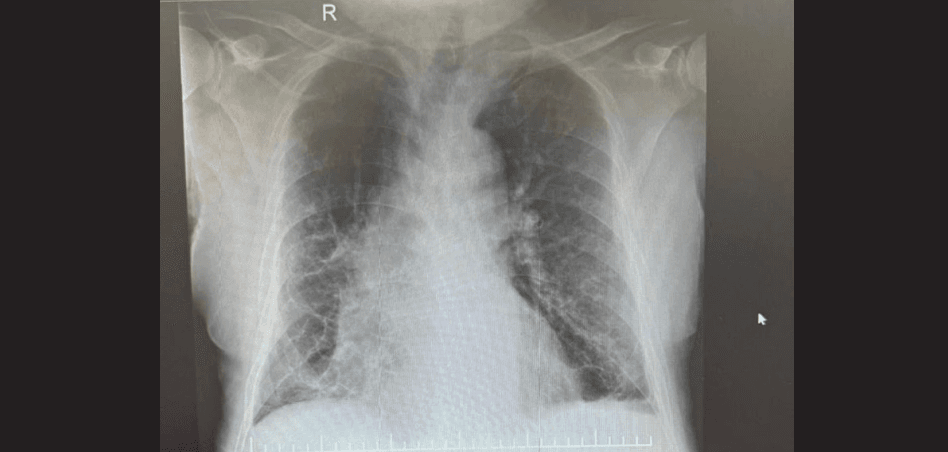
Figure 1: RChest radiograph showing bilateral lower-zone fibrotic changes with patchy opacities suggestive of infective exacerbation in long-standing bronchiectasis.
Diagnosis
Acute infective exacerbation of bronchiectasis complicated by severe acute-on-chronic hypercapnic respiratory failure.
Management
The patient was managed in the Intensive Care Unit (ICU) with carefully titrated oxygen therapy targeting oxygen saturation between 88% and 92%. NIV was initiated promptly using BiPAP support. Additional treatment included broad-spectrum intravenous (IV) antibiotics, inhaled bronchodilators, nebulisation, airway clearance therapy, and intensive chest physiotherapy. Serial ABG monitoring was performed to assess the therapeutic response. Endotracheal intubation was avoided due to gradual clinical and biochemical improvement.
Outcome
Over subsequent days, progressive reduction in PaCO2 levels and correction of respiratory acidosis were observed. Respiratory distress improved, oxygen requirements decreased, and the patient was successfully transferred out of the ICU after stabilisation.
Discussion
Bronchiectasis predisposes patients to recurrent respiratory infections, mucus retention, and chronic airflow obstruction, all of which contribute to progressive ventilatory impairment. 4 Long-standing disease may lead to chronic CO 2 retention with renal metabolic compensation. However, acute infective exacerbations can precipitate sudden ventilatory decompensation and severe hypercapnic respiratory failure.
Extreme hypercapnia is associated with significant physiological consequences, including cerebral vasodilation, altered mental status, increased intracranial pressure, and cardiovascular compromise. 5 The successful outcome in this case highlights the importance of early recognition and prompt intervention.Current evidence supports the use of NIV as first-line therapy in acute hypercapnic respiratory failure because it improves gas exchange, reduces respiratory muscle fatigue, shortens the duration of ICU stay, and decreases mortality.6
Careful oxygen titration is equally important because uncontrolled oxygen administration may worsen hypercapnia through increased ventilation–perfusion mismatch and reduced hypoxic respiratory drive. 7 In the present case, timely institution of NIV, controlled oxygen therapy, antimicrobial treatment, and chest physiotherapy contributed to rapid stabilisation and the avoidance of invasive mechanical ventilation.
Conclusion
Severe acute-on-chronic hypercapnic respiratory failure may complicate infective exacerbations of bronchiectasis. Even markedly elevated PaCO2 levels may be reversible with early recognition and aggressive non-invasive management. Prompt initiation of NIV, controlled oxygen administration, and treatment of the underlying infection are critical for favourable outcomes.
Azhar Khan, Sanjay Kriplani, Manoj Pethe. Severe Acute-on-Chronic Hypercapnic Respiratory Failure in
LongStanding Bronchiectasis: A Case Report. MMJ. 2026, June. Vol 3 (2).
DOI: XXXX-XXXX
References
- Chalmers JD, Aliberti S, Blasi F. Management of bronchiectasis in adults. Eur Respir J. 2015;45(5):1446–62.
- Hatipoğlu U, Aboussouan LS. Chronic hypercapnic respiratory failure and non-invasive ventilation in people with chronic obstructive pulmonary disease. BMJ Med. 2022;1(1):e000146.
- Sankari A, Bora V. Noninvasive Ventilation. In: StatPearls [Internet]. Treasure Island (FL): StatPearls Publishing; 2026. Available at: https://www.ncbi.nlm.nih.gov/books/NBK578188/. Accessed on: 15th May 2026.
- Bird K, Memon J. Bronchiectasis. In: StatPearls [Internet]. Treasure Island (FL): StatPearls Publishing; 2026. Available at: https://www.ncbi.nlm.nih.gov/books/NBK430810/. Accessed on: 15th May 2026.
- Almanza-Hurtado A, Polanco Guerra C, Martínez-Ávila MC, et al. Hypercapnia from Physiology to Practice. Int J Clin Pract. 2022;2022:2635616.
- Mas A, Masip J. Noninvasive ventilation in acute respiratory failure. Int J Chron Obstruct Pulmon Dis. 2014;9:837–52.
- Abdo WF, Heunks LM. Oxygen-induced hypercapnia in COPD: myths and facts. Crit Care. 2012;16(5):323.