 WhatsApp Us (24/7)
 +91 926 888 0303 (24/7)


Abstract:
Scrub typhus, caused by the obligate intracellular bacterium Orientia tsutsugamushi and transmitted via bites from infected larval trombiculid mites (chiggers), remains a significant zoonotic threat in the Asia-Pacific "tsutsugamushi triangle" and beyond, with emerging cases reported globally. Initial manifestations often mimic undifferentiated febrile illnesses, including fever, headache, myalgia, eschar formation, and lymphadenopathy, complicating early diagnosis. The disease can rapidly progress to severe complications in 20%–30% of untreated cases, driven by endothelial damage, vasculitis, and cytokine-mediated multi-organ dysfunction. Common complications include hepatic dysfunction (77%), pneumonitis or acute respiratory distress syndrome (ARDS; 7%–54%), acute kidney injury (4%–10%), myocarditis, encephalitis, disseminated intravascular coagulation (DIC), shock, with mortality rates ranging from 3.8% overall to 24% in intensive care settings with multi-organ failure. Early empirical therapy with doxycycline is critical to mitigate progression.
Key words: Scrub Typhus, Scrub Typhus Complication, Myositis, Polyneuropathy.
Introduction
Scrub typhus, caused by Orientia tsutsugamushi , continues to impose a substantial public health burden across the Asia-Pacific region. 1,2 In India, systematic reviews highlight its increasing prevalence, particularly in southern and northern regions, where it accounts for substantial morbidity beyond its classic eschar and fever presentation. 2 In Southern India, a study described the diverse clinical profile of scrub typhus and highlighted an encouraging trend of improving mortality rates with timely diagnosis and treatment. 3 However, experience from a tertiary care centre in Northern India has shown that scrub typhus infection is not a benign disease and can lead to serious complications. 4 Neurological involvement in scrub typhus, though relatively uncommon, includes a broadening spectrum of central and peripheral nervous system manifestations. 5 Severe systemic infections such as scrub typhus can additionally precipitate critical illness polyneuropathy, and myopathy. 6, 7 Rare neurological and neuropsychiatric presentations of scrub typhus have been documented in a case series of 10 patients from eastern India. 7 Muscle involvement is also well recognised; a dedicated study reported clinical and electrophysiological evidence of myositis in approximately 39% of scrub typhus patients, often with histopathological features of inflammatory myopathy and vasculitis. 4,7,8 We report a case of scrub typhus manifesting as encephalitis, myositis, and polyneuropathy, emphasising early recognition and targeted therapy to improve outcomes.
Case Report
A 40-year-old male resident of Baitul, Madhya Pradesh, came to the emergency department with fever, chills and headache for 8 days, along with pedal oedema for the past 3 days. The patient had previously been admitted to another hospital for fever associated with thrombocytopenia.
Outside report showed platelet count 60,000/µL, serum glutamic-oxaloacetic transaminase (SGOT) of 110 U/L, and C-reactive protein (CRP) of 91 mg/L. On examination, the patient was febrile, tachypnoeic, irritable, and drowsy in nature. A black-coloured eschar was present on the right thigh (Figure 1). The patient’s temperature was 38.1° C, blood pressure was 90/60 mmHg, and pulse rate was 108/min. On systemic examination, the cardiovascular system and per abdomen findings were normal. Respiratory system (RS) examination revealed bilateral crepitations, while central nervous system (CNS) examination showed drowsiness and irritability, with a Glasgow Coma Scale (GCS) score of E4V4M5 (E = Eye response, V = Verbal response, M = Motor response). The patient was admitted to the Intensive Care Unit (ICU). As the patient was tachypnoeic with severe hypoxia, he was intubated and placed on mechanical ventilation. He was sedated and started on inotropic support for hypotension.
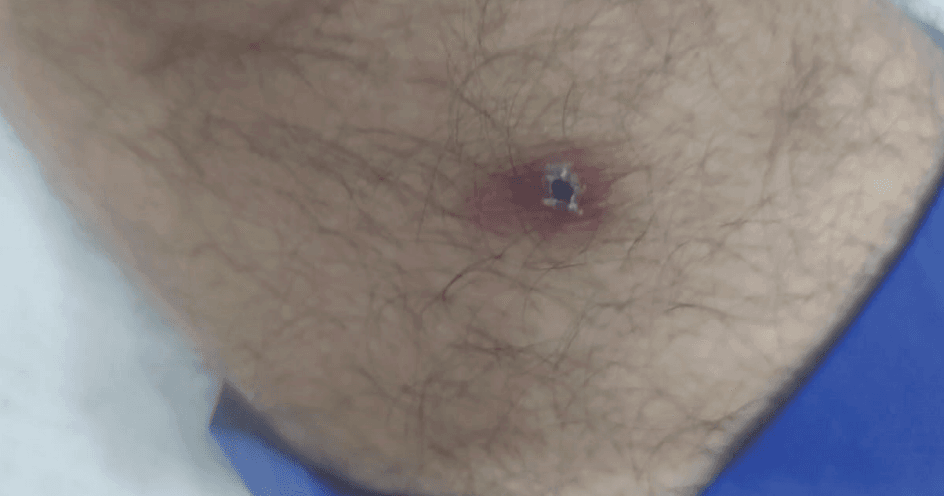
Figure 1: Eschar on right thigh.
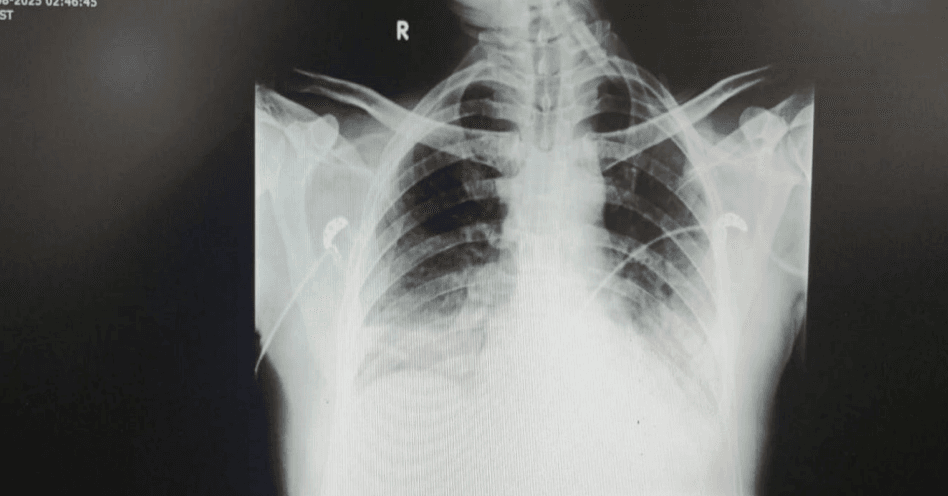
Figure 2: Chest X-ray showed bilateral lower lobe opacities.
Routine investigations revealed CRP of 96 mg/L. Complete blood count (CBC) showed haemoglobin (Hb) of 17.6 g/dL, platelet count of 23,000/µL, and total leucocyte count (TLC) of 12,000/µL. Liver function tests (LFTs) showed SGOT/aspartate aminotransferase (AST) of 169 U/L, serum glutamic-pyruvic transaminase (SGPT)/ alanine aminotransferase (ALT) of 106 U/L, total bilirubin of 5.48 mg/dL, and albumin of 2.1 g/dL. Renal function tests (RFTs) revealed sodium (Na+) of 142 mEq/L, potassium (K+) of 4.5 mEq/L, and creatinine of 1.7 mg/dL (Table 1). Chest X-ray showed bilateral lower lobe opacities (Figure 2). Scrub typhus immunoglobulin M (IgM) was positive. Twodimensional echocardiography (2D echo) showed an ejection fraction (EF) of 55% with mild pericardial effusion.
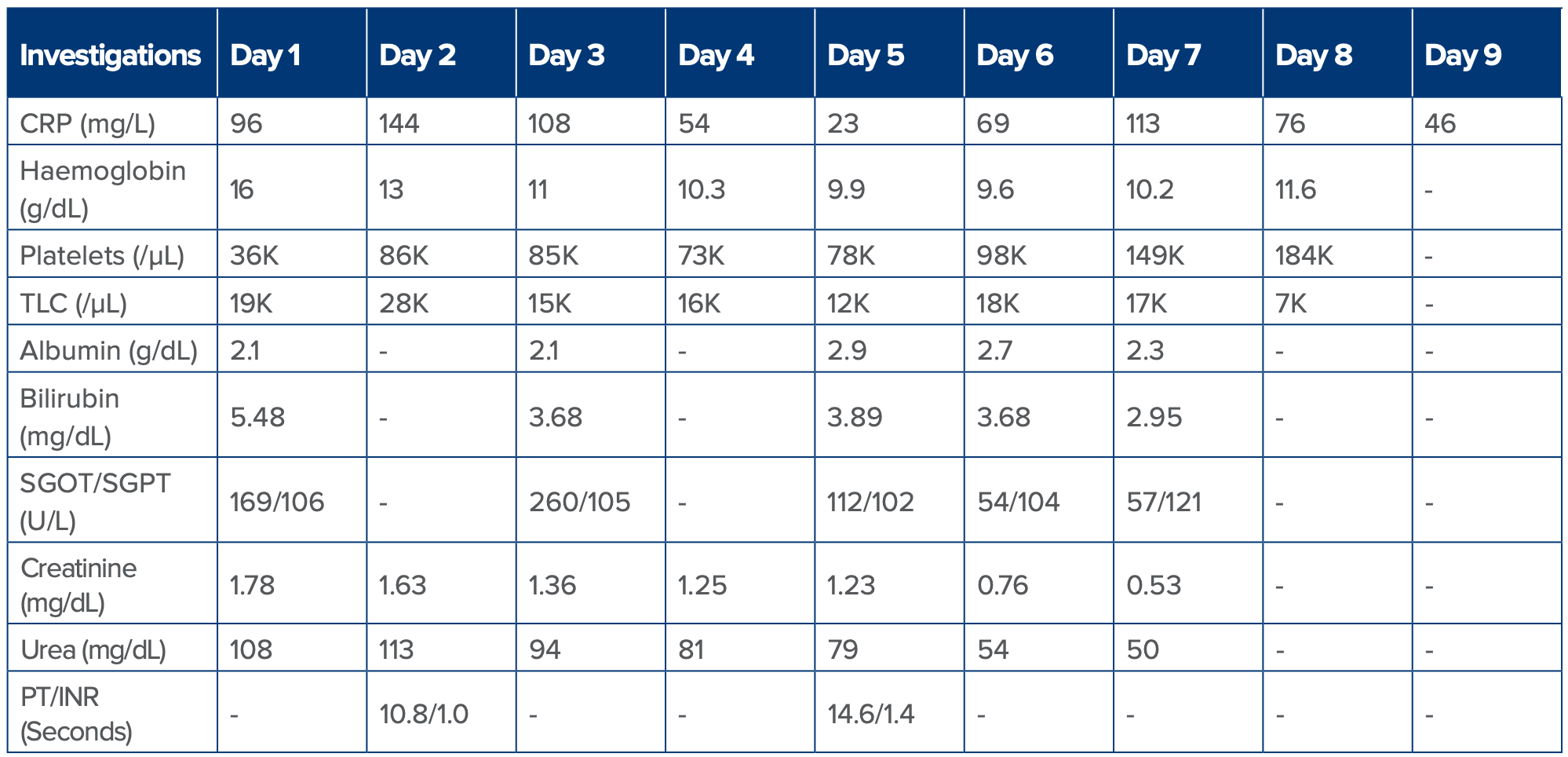
Table 1: Baseline laboratory investigations of the patient.
Abbreviations: CRP: C-Reactive Protein; INR: International Normalised Ratio; PT: Prothrombin Time; SGOT: Serum GlutamicOxaloacetic Transaminase; SGPT: Serum Glutamic-Pyruvic Transaminase; TLC: Total Leucocyte Count. Computed tomography (CT) of the thorax showed mildto-moderate pleural effusion and severe ground-glass opacities throughout the bilateral lung parenchyma, with features suggestive of pulmonary oedema. The patient was treated for septic shock with multiorgan dysfunction syndrome and encephalopathy. Intravenous doxycycline and azithromycin were started along with diuretics. Neurology opinion was taken in view of seizures. CT of the brain showed minimal subarachnoid haemorrhage (SAH) along the bilateral frontal and right temporal lobe sulci. Electroencephalography (EEG) showed generalised slowing of rhythm suggestive of encephalopathy. The GCS score dropped to E2VTM2. A single donor platelet transfusion was administered for thrombocytopenia. Tracheostomy was performed and the patient gradually responded to the given line of treatment. Magnetic resonance imaging (MRI) of the brain showed post-ictal changes along with resolving SAH. Endotracheal (ET) culture showed Klebsiella pneumoniae and Pseudomonas, sensitive to tigecycline; hence, antibiotics were escalated according to sensitivity pattern, and the patient was shifted to the ward. In view of motor weakness, nerve conduction studies (NCS) were performed, which showed bilateral symmetrical sensorimotor axonal polyneuropathy in both upper and lower limbs. Creatine phosphokinase-MB (CPK-MB) was 1117 U/L. Daily physiotherapy and chest physiotherapy were continued. In view of myositis, steroid pulse therapy was administered for 3 days, following which the patient responded. Tracheostomy was closed on the 18th day of the illness. Lab parameters gradually improved, acute kidney injury (AKI) resolved, respiratory infection subsided, and the patient was discharged home.
At follow-up after 5 days, the patient showed improvement in motor function; however, speech dysfunction and behavioural abnormality persisted. Follow-up investigations showed CBC with Hb 12.1 g/dL, TLC of 5230 /µL, and platelet count of 396,000/µL. LFT revealed albumin of 2.3 g/dL, total bilirubin of 1.03 mg/dL, SGOT of 39 U/L, and SGPT of 54 U/L. CRP was 6.9 mg/L, and creatinine was 0.69 mg/dL.
At 2 months of follow-up, motor recovery was good. he patient was able to walk without support, move all four limbs, and take oral feeds; however, behavioural abnormalities, abusive language, aggression and irritability persisted.
At 3 months of follow-up, behavioural abnormalities, abusive language, aggression, and irritability showed improvement.
Discussion
In the present case, the patient developed encephalitis as a prominent complication of scrub typhus, which aligns with documented reports of CNS invasion by the organism, leading to diffuse or focal inflammatory changes. Acute manifestations such as altered mental status and seizures are commonly reported, whereas myositis and polyneuropathy with scrub typhus are rarely described. 9 The long-term sequelae, particularly cognitive decline, represent an underappreciated aspect of the disease.
Emerging evidence indicates that scrub typhusassociated encephalitis can result in persistent neurological impairment in a subset of survivors. Follow-up studies in paediatric cohorts with scrub typhus meningoencephalitis have shown that while the majority (approximately 89%–90%) achieve full recovery within one year, 10%–11% experience residual sequelae, including minor to severe impairments such as epilepsy, focal neurological deficits, behavioural issues, intellectual disability, speech difficulties, and motor disabilities. 8 Although data in adults are more limited, myositis and polyneuropathy (complex neurological signs including peripheral nerve involvement) were reported among rare neurological manifestations, though exact prevalence figures for neuropathy alone were not provided. 7 Muscle involvement (clinical/ myopathic changes) appears to be more common than peripheral neuropathy, with one research report suggesting that muscle involvement may be present in up to ~40% of scrub typhus patients when assessed objectively by electromyography (EMG) and biopsy findings. 5
Cognitive decline following scrub typhus encephalitis may stem from direct neuronal injury, hypoxic-ischaemic damage secondary to multi-organ failure (e.g., respiratory or cardiovascular compromise), or immunemediated processes persisting beyond bacterial clearance. In encephalitis survivors broadly, memory impairment is one of the most disabling long-term effects, often requiring neuropsychological assessment and targeted rehabilitation.
Early diagnosis and prompt initiation of appropriate antimicrobial therapy (doxycycline or azithromycin) remain critical, as delays contribute to severe CNS involvement and poorer outcomes. In cases with encephalitis, adjunctive supportive care, including management of raised intracranial pressure, seizures, and multi-organ support, is essential.
Declarations
Patient consent Written informed consent was obtained from the patient for publication of this case report and accompanying clinical details.
Conflicts of interest The authors declare no conflicts of interest.
Conclusion
Scrub typhus remains an important but treatable cause of meningoencephalitis. Although most patients recover fully with timely doxycycline-based therapy, a minority experience minor to severe sequelae, emphasising the value of early recognition, specific treatment, and structured long-term follow-up.
Nitin Dambhare, Nikhil Dongre, Pavan Kale. Scrub Typhus Causing Encephalitis, Myositis, and Polyneuropathy: A Case Report. MMJ. 2026, June. Vol 3 (2).
DOI: XXXX_XXXX_XXXX_XXXX
References
- Bonell A, Lubell Y, Newton PN, et al. Estimating the burden of scrub typhus: A systematic review. PLoS Negl Trop Dis. 2017;11(9):e0005838.
- Devasagayam E, Dayanand D, Kundu D, et al. The burden of scrub typhus in India: A systematic review. PLoS Negl Trop Dis. 2021;15(7):e0009619.
- Varghese GM, Trowbridge P, Janardhanan J, et al. Clinical profile and improving mortality trend of scrub typhus in South India. Int J Infect Dis. 2014;23:39–43.
- Jain D, Nand N, Giri K, et al. Scrub typhus infection, not a benign disease: an experience from a tertiary care center in Northern India. Med Pharm Rep. 2019;92(1):36–42.
- Kalita J, Misra UK, Mani VE, et al. A study of muscle involvement in scrub typhus. J Neurol Sci. 2015;348(1-2):226–30.
- Visser LH. Critical illness polyneuropathy and myopathy: clinical features, risk factors and prognosis. European Journal of Neurology. 2006;13:1203–21.
- Ghosh R, Mandal A, León-Ruiz M, et al. Rare neurological and neuropsychiatric manifestations of scrub typhus: a case series of 10 cases. Neurologia (Engl Ed). 2024;39(9):766–80.
- Jim WT, Chiu NC, Chan WT, et al. Clinical manifestations, laboratory findings and complications of pediatric scrub typhus in eastern Taiwan. Pediatr Neonatal. 2009;50(3):96–101.
- Sayen JJ, Pond HS. Scrub typhus in Assam and Burma; a clinical study of 616 cases. Medicine (Baltimore). 1946;25:155–214.