 WhatsApp Us (24/7)
 +91 926 888 0303 (24/7)


Abstract: Acute fatty liver of pregnancy (AFLP) is one of the most dreaded complication that typically manifests in late gestational period. It rapidly progresses to fulminant hepatic failure, fetal complications & high mortality. Timely diagnosis & intensive treatment with multidisciplinary team management reduces significant morbidity & mortality. Here we discuss a case of young primigravida who presented with progressive jaundice with signs of liver failure & fetal distress at 34 weeks of gestational age without any gestational comorbidities. Inspite of immediate She was immediately delivery by caesarean section, she developed multiorgan failure & disseminated intravascular coagulation (DIC), required continuous renal replacement therapy, other organ support & psychiatric management.
Key words: Acute Fatty Liver in Pregnancy, Free Fatty Acids in Pregnancy, DIC, Obstetric Emergency, Hepatic Encephalopathy
Introduction
Pregnancy specific liver disorders comprise Intrahepatic cholestasis of pregnancy, haemolysis, elevated liver enzymes, and low platelets (HELLP) syndrome and Acute fatty liver of pregnancy (AFLP) among which, AFLP is an obstetric emergency characterized by maternal liver dysfunction with progression to fulminant liver failure, devastating maternal and fetal complications, including death. Urgent delivery and organ supportive maternal care are important for obtaining a full recovery. Acute fatty liver of Pregnancy is a rare but fatal disease, with an approximate incidence of 1 in 7000 to 20,000 pregnancies. Free fatty acids normally increase in pregnancy, particularly in late gestation, to enhance the growth of feto-placental unit. Any defect in the metabolism of fatty acid oxidation will generate toxic metabolites of long chain fatty acids which eventually infiltrate hepatocytes and cause hepatic failure. Approximately 20 % of AFLP cases are associated with mutation of fetal Long-chain 3-hydroxyacyl-CoA dehydrogenase (LCHAD) enzyme.1 It typically presents between 30th to 38th week of gestation. The initial symptoms are often nonspecific (e.g., nausea, vomiting, abdominal pain, malaise, headache, and/ or anorexia) and hence, difficult to differentiate it from HELLP syndrome. Hypertension with or without proteinuria is most common presenting feature. Coexisting haemolysis, elevated liver enzymes, and low platelet count syndrome occurs in 20 %, and 20 to 40 % of patients are also diagnosed with preeclampsia. Clinical features of acute liver failure include jaundice, ascites, encephalopathy, disseminated intravascular coagulopathy, and hypoglycemia. Most patients develop acute kidney injury, and often progress to multiorgan failure. Risk factors for acute fatty liver of pregnancy include Foetal LCHAD deficiency, Prior episode of AFLP, Multiple gestation, Preeclampsia or haemolysis, elevated liver enzymes, and a low platelet count syndrome, Male fetal sex, Low body mass index (BMI <20 kg/ m2) and Nulliparity.2
Case
A 26-year-old female, primigravida,34 weeks of gestational age, married life of 3 years was admitted to the Emergency Department (ER) with history of per vaginal bleeding and abdominal pain for 1 hour, pruritus and scleral icterus since 15 days. She was evaluated in the emergency room itself, found to have raised Blood Pressure -150/100 mmHg with tachycardia-118/min and presence of icterus. On abdominal examination, fundal height was 28 weeks with Fetal tachycardia-194/min. Immediate non-stress test (NST) done which showed reduced beat to beat variability with variable decelerations. Ultrasound revealed single live intra uterine foetus with birthweight approx. 1 kg, AFI- 3 cm and normal doppler. Her blood investigations revealed hyperbilirubinemia 12.3, SGOT –45, SGPT- 29, PT - 9.2 APTT –33.7 INR-1.81, Creatinine - 3.07, Serum ammonia was- 93, TLC-21210, plt count-1.2 lac. In view of nonreactive NST and excess bleeding p/v –the multidisciplinary team (MDT) was called and decision of emergency caesarean section taken. In view of coagulopathy, patient was transfused 4 units of fresh frozen plasma (FFP) and Caesarean section proceeded, patient delivered a preterm male baby weighing 900 gm, cried immediately after birth and shifted to neonatal intensive care unit (NICU). Post operatively patient was shifted to ICU for further monitoring.
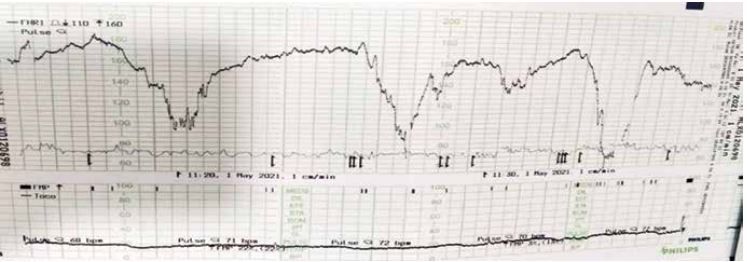
Figure 1: Non Reactive Stress Test
A diagnosis of Acute fatty liver pregnancy with acute liver failure and encephalopathy was considered. Postoperatively, the patient had continuous oozing from suture site despite correcting coagulopathy, so vacuum assisted closure (VAC) dressing was done.
On post-operative day 2, she developed acute respiratory distress syndrome (ARDS) and sepsis with septic shock. She was intubated and put on mechanical ventilatory support. She required ionotropic support and broad-spectrum antibiotics. Her liver function further deteriorated, with bilirubin was raised to 18. She developed delirium, hepatic encephalopathy and recurrent hypoglycaemia. She was treated with hepatoprotective protocols. In view of rising creatinine and reduced urine output CRRT started. After a stormy course of approximately 1 week in ICU, she gradually improved, extubated and discharged home on Day 18 of hospitalization. Baby was discharged from NICU after 1 month once he reached 1800 gm of weight. with health baby.
Discussion
Acute fatty liver of pregnancy is an unique obstetric emergency and carries high morbidity and mortality. Our patient developed Liver failure, coagulopathy, haemorrhage, renal failure, and severe infection which was lethal for her. Other differential diagnosis is HELLP syndrome and Acute viral hepatitis.There is complete difference between etiopathogenesis of HELLP syndrome & AFLP.3 Acute fatty liver of pregnancy develops due to a deficiency of fatty acid oxidizing enzymes while HELLP syndrome is caused by endothelial injury leading to periportal hepatic edema, hemorrhage, and necrosis. It is always challenging to differentiate AFLP from HELLP syndrome or severe preeclampsia in some cases. AFLP predominantly causes more abnormal coagulation and clotting problems while patients with HELLP syndrome tend to have a more progressive thrombocytopenia. Acute viral hepatitis was ruled out with negative antibody detection. (TTP-HUS) Thrombotic thrombocytopenic purpura-Haemolytic uremic syndrome could be ruled out with appropriate lab tests along with negative ADAMTS 13. In this case, AFLP could not be diagnosed for almost a month before her referral to our centre which finally led to life threatening hepatic failure and sepsis. She developed liver failure, acute pulmonary oedema, bilateral pleural effusion and bilateral bacterial pneumonia with renal failure with Disseminated intravascular coagulation (DIC). Expectant management is not recommended and have a very low quality evidence. This patient underwent immediate delivery in spite of which she worsened and developed multiorgan failure. Caesarean delivery had to be performed in this case due to maternal and fetal distress and deterioration which was done under prophylactic platelets and FFP transfusion. Newborn was monitored for hypoglycaemia. Liver enzymes took > 2 weeks to settle down. In this case, Coagulopathy and encephalopathy was out of proportion. Clinical confusion also arose due to close differential diagnosis of hepatic encephalopathy with postpartum psychosis.
CONCLUSION:
Acute fatty liver of pregnancy is rare disorder which is difficult to distinguish from Pregnancy induced hypertension (PIH), HELLP syndrome and thrombotic thrombocytopenic purpura (TTP) Haemolytic uremic syndrome (HUS). These patients need immediate delivery and organ support therapy to manage life threatening complications.
References
- Hadi Y, Kupec J. Fatty Liver in Pregnancy. [Updated 2023 Jul 4]. In: StatPearls [Internet]. Treasure Island (FL): StatPearls Publishing; 2024 Jan-. Available from: https://www.ncbi.nlm. nih.gov/books/NBK545315/
- Acute fatty liver of pregnancy - UpToDate
- Ramanathan R, Ibdah JA. Mitochondrial dysfunction and acute fatty liver of pregnancy. International Journal of Molecular Sciences. 2022 Mar 25;23(7):3595.