 WhatsApp Us (24/7)
 +91 926 888 0303 (24/7)


Abstract: Workplace stress is the generally focused area of stress majorly affecting balance between an individual’s personal life and professional life. This article focuses on the extent to which the working women manage work-life pressure along with maintaining their physical and emotional well-being through their engagement into religious activities most importantly. It compares the potential of work-life balance, engagement into religiosity and ability to experience the well-being amongst working married and unmarried women. To fulfill the objective, the data was collected from 100 working women with 50 each from married and un-married residing in Delhi-NCR, India. The age range of the sample was 25-45 years. The Work-Life Balance scale along with the The Centrality of Religiosity and Ryff’s psychological wellbeing scale with the 6 dimensions – Self Acceptance, Purpose of Life, Personal Growth, Positive Relations, Autonomy and Environmental Mastery to measure all the 3 variables were administered to the women. Three Parametric Statistical techniques were applied, including ancova, correlation and regression, to find out the results of comparison between all the 3 variables. The findings demonstrated a high religiosity in married women, high self- acceptance in unmarried women. There was also a negative correlation between work life balance and purpose of life, and a negative correlation between autonomy and environmental mastery. At last, only 1 variable which is purpose of life majorly impacts work life balance out of all the 7 variables taken, in the working women.
Key words: Work Life Balance, Religiosity, Well-being, Married and Unmarried Working Women
Introduction
Nature created man and woman equal and therefore guarantees equal status to both, if it was so then what are the circumstances which caused the downfall of the status of women in Indian society.1 It is not that the women were in the state of suppression since ancient times, but there have been bright phases also though very brief and temporary. Discrimination against the women violates the principles of equality of rights and is an obstacle to participation of women on equal terms with men in political, social, economic and cultural lives.2 So, the question here arises that - What is the position of women in this age of advancement and culture? Despite social reforms movement, constitutional and legal provisions aimed at securing equal status for women, women continue to suffer from inequalities and are victims of increasing tide of violence. The need to keep the women economically dependent was closely linked to conservative fear of women sexuality and a corresponding notion that independent women may ‘go astray.’ Social conditions were created and enforced to keep women perpetually in the economic bondage so that male control over them can be maintained.
To preserve the economic subordination of women within marriage, her role as housewife is glorified which gives a false sense of security to married women. But neither the law nor the society recognizes their role of women as home maker in true economic terms. According to a McKinsey Report, gender-based progress has stalled in recent years.3 The wage gap, gender-based discrimination, and sexual harassment persist. Due to so many problems with the working women, some measures were taken to reduce and eventually eradicate the improper actions against women along with the absolute steps taken up by government: ending male dominated culture at the work place, like allowing females to head the meetings, initiate video conferencing, to go on the business trips, organizing leisure excursions. Such activities promote confidence amongst women and lessen the gender gap at the workplace. Maternity leaves are in trend in many offices but some of them are unpaid even if it ensures the job security. Married women take better care of their households but dropouts from work are eventually higher on their part. Belonging to any religion, the cultural and spiritual beliefs that are formed since childhood influence the working women’s peace of mind at the work and at home. After industrialization and urbanization, role of women has shifted from just taking care of husbands, in-laws and children to working in fields which are now not limited to just pink-collar jobs anymore. While taking up the population of working women, Learning the interaction of aspects below are considered as important.
Work life balance is the competent level of involvement between work place and home environment for a person. The aim should be to maintain a fine equilibrium between multiple roles of a person as a worker as well as a social person involving the interaction with peers, parents, kids, siblings etc. Sometimes, these multiple roles align together sometimes do not which leads to conflicting situations. Religiosity is the extent to which a person believes in god, almighty and the religious institutions. To what extent the ideologies and commitments influence a person’s daily professional and personal life as they engage in religious activities in order to connect with the god. Women are taught spiritual prophecies, enrolled in religious institutions, performing religious practices because it is always felt that as compared to males, females are more religiously involved and the believers of divinity and sacred faiths. Psychological Well-Being is a state of mind which involves conscious awareness leading to positive life balance with the satisfaction and contentment. WHO has defined positive mental health as “a state of well-being in which the individual realizes his or her own abilities, can cope with the normal stresses of life, can work productively and fruitfully, and is able to make a contribution to his or her community.”4
Review of literature
The supporting researches addressed in the results section are to recognize profoundly about the present framework of working married and unmarried women in the 21st century employed in various sectors with respect to studying the contrast of different variables and elaborating their meaning, factors, and findings.
The current research is conducted to know how Work-life balance, Religiosity and Psychological well-being affect married and unmarried women and to what extent they are able to deal with the external and internal situations of their life, overcoming with all the obstacles that come through their way. Understanding work-personal life pressure, effect of religious liberalism, conservativeness and psychological well-being with negative work-environmental factors is essential because if married females have a household to take care of then unmarried females must tackle the negative and degrading remarks every day. This gave rise to the importance of following objectives and further the hypothesis of the study:
Objectives
1. To find out the difference between married and unmarried working women on work life balance, religiosity, and psychological well-being.
2. To find out the relationship amongst work life balance, religiosity and psychological well-being in working women.
3. To find out the impact of psychological well-being and religiosity on work life balance in working women.
Hypothesis
H1. There will be a significant difference between married and unmarried working women for the following variables: H1.1. Work life balance, H1.2. Religiosity, H1.3. Psychological well-being.
H2. There will be a significant relationship between work life balance, religiosity and psychological well-being in working women.
H3.1. There will be significant impact of following dimensions of psychological well-being on work-life balance in working women: (a) Autonomy, (b) Environmental Mastery, (c) Personal Growth, (d) Positive Relations, (e) Purpose in life, (f) Self-Acceptance.
H3.2. There will be significant impact of Religiosity on work-life balance in working women
Methods
Research design
Correlational research: It is a type of non-experimental research method, and a preliminary way to gather information about a topic in which a researcher measures two variables This research can reveal if a relationship exists between variables.
Total: There were overall 100 participants, out of which 50 were married working women and 50 unmarried women.
Sampling: Convenient and Purposive sampling.
Age range: 25 – 45 years (Mean Age - 30.95)
Sample Collection: Private and Government sectors of MNC’s, Banks, Universities and Schools of Delhi, NCR.
Inclusion Criteria: Age range is 25-45 years; Middle age working women; Married working women; Unmarried working women.
Tools for data collection: Every questionnaire was self-administered.
1. The work life balance inventory: Fisher developed the 15- item scale.5 It was later adapted by Hayman.6 It is a 5 point scale ranging from strongl y agree to strongly disagree. Reliability for the scale was estimated using Cronbach alpha coefficient that came .91 for WIPL, .82 for PLIW and .67 for WPLE.
2. The centrality of religiosity scale (CRS): It is a measure of the centrality and importance of religious meanings in the personality developed by Huber and Huber.7 The 15 questions covers five core dimensions from a sociological and psychological perspective. This 5 point scale ranges from never to very often. The reliabilities of the individual dimensions ranged from 0.80 to 0.93, and from 0.92 to 0.96 for the whole CRS 15.
3. Ryff’s scales of psychological wellbeing: Developed by psychologist Ryff.8 The 42-item Psychological Wellbeing (PWB) Scale measures six multi-aspects of wellbeing and happiness: autonomy, environmental mastery, personal growth, positive relations with others, purpose in life, and self-acceptance. The internal consistency coefficients were quite high (between 0.86 and 0.93) and the test-retest reliability coefficients for the participants within six weeks period were also high (0.81-0.88).
Procedure
After taking permission from the workplaces, we gave all the 3 questionnaires (along with a demographic sheet) to the working women (50 married and 50 unmarried) manually by visiting there, as well as at the homes of familiar women ensuring they are seated in a comfortable space. They were given simple instructions to rate how strongly they agree or disagree with all the statements by looking through their feelings and believes. After they filled the questionnaires, a kind gesture of than you was expressed.
Statistical analysis
Objective 1 - To know difference between married and unmarried working women on work life balance, religiosity and psychological well-being, the analysis of covariance was applied, i.e. Ancova.
Objective 2 - To find out the relationship amongst work life balance, religiosity and psychological wellbeing in working women, Pearson correlation was implemented.
Objective 3 - To find out the impact of psychological well-being and religiosity on work life balance in working women, technique of Regression was used.
Result
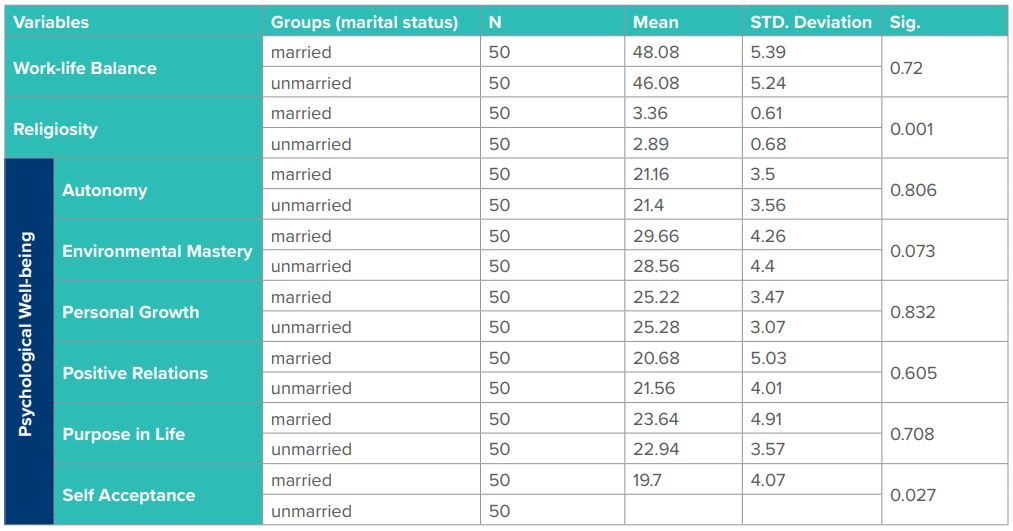
Table 1: Showing difference between work life balance, religiosity and psychological wellbeing in married and unmarried working women, N=50 (age covariant)
This result table shows the relationship between all 3 variables amongst the sample by application of statistical technique of ANCOVA. Here the age is taken as a covariant which is also known as the predictor variable or explanatory variable and provides as a descriptor parameter for the sample.

Table 2: Showing the relationship between work life balance, religiosity and psychological wellbeing in working women, N= 100. *. Correlation is significant at the 0.05 level (2-tailed). **. Correlation is significant at the 0.01 level (2-tailed)
This result table shows the relationship between all 3 variables amongst the total sample of working women by application of statistical technique of correlation. The pearson correlation used, is a statistical measure to find the extent to which variables are linearly correlated, given that both the variables are normally distributed.

Table 3: Showing the impact of psychological wellbeing and religiosity on work life balance, N= 100
This result table shows statistical technique of Regression determining how a variable of interest (dependent variable) is affected by one or more variables (independent variables) on a sample of working women. The variable of interest here is Work life balance and the independent variables taken are psychological wellbeing and religiosity
Discussion
Objective 1. To find out the difference between married and unmarried working women on work life balance, religiosity and psychological well-being.
Hypothesis 1.1. There will be a significant difference between married and unmarried working women for the Work life balance. The hypothesis is not accepted as there is no significant difference between married and unmarried working women on work life balance. As for both of the groups maintenance of home and work responsibility requires same amount of hard work.
In the context of work-personal life balance, investigations showed the influence of gender and tenure status in balancing parenthood and career and results revealed that women reported greater career and family stress combined with less institutional support for balance of work and family as compared to men.9
Hypothesis 1.2. There will be a significant difference between married and unmarried working women for the Religiosity. The hypothesis is accepted as significantly married working women have more religiosity than unmarried working women. The mean score of married working women is higher (3.36) than the mean score of unmarried working women (2.894). Married working women indulge themselves in religious practices more as compared to unmarried working women, with a belief of such godly and devotional enactments make themselves and their families mentally well prepared for future uncertainties.
A few researchers concluded that one could be married and play the role of wife, mother, householder and executive effectively and yet experience not more role stress than their single counterparts. This research explains that there is no difference in pressure experienced by married and unmarried employed women.10
Hypothesis 1.3. There will be a significant difference between married and unmarried working women for the Psychological Well-being. There is a significant high self-acceptance, in 1 domain of psychological wellbeing amongst unmarried working women than married working women, hence hypothesis is partially accepted. The dimension of Self-Acceptance, which belongs to Psychological well-being, shows that the married employed women scored low on the domain of self-acceptance (19.7) as compared to the unmarried employed women (21.1). Unmarried women shows a high self-acceptance as they feel in charge of their lives, have confidence in their opinions and trying to have a particular aim in life. They are pleased how things turned out after they’ve worked hard for it and accept their results positively.
A study measured the impact of work pressure on family life and the expectations of family on the work commitments on 120 teachers of different educational institutes. The study revealed that factors like negative attitude of family, family commitments, health issues, long working hours, meetings, work load created an imbalance in their personal and professional lives.11
Objective 2. To find out the relationship amongst work life balance, religiosity and psychological wellbeing in working women.
Hypothesis 2. There will be a significant relationship between work life balance, religiosity and psychological well-being in working women. The hypothesis is partially accepted as there is a significant relationship between: Work life balance and 1 domain of psychological well-being i.e. purpose in life, and, 2 domains within psychological well-being itself, which are autonomy and environmental mastery. There is a negative correlation between Work life balance and one domain of Psychological wellbeing which is, Purpose in life (-0.218). A high purpose of life strongly indicates less work-life balance as more a women wants to grow with respect to a meaningful purpose in her life, more the office and personal life demands will be challenging for her mental and physical health.
There is also a negative correlation between both the domains of psychological well-being which are autonomy and purpose in life (-0.295). This can be because more they acquire a moral and independent thinking lifestyle, control over the surrounding societal events unavoidably lessens.
The researchers have highlighted that religion emphasizes marriage and couples who believe in religion make a stronger marital commitment, which strengthens their marital relationship. This indicates that marriage and religiosity are positively linked and couples have more stable married life.12 A study reveals that parents’ attendance in religious services is related to young children’s greater self-control, more positive social interactions, and better interpersonal skills, as well as less impulsivity.13 An old study firmly claimed that women’s participation in the labor market is rather the consequence of the secularization process, which has led to different attitudes and behaviors in western industrialized countries.14
Objective 3. To find out the impact of psychological well-being and religiosity on work life balance in working women.
Hypothesis 3.1. There will be significant impact of following dimensions of psychological well-being on work-life balance in working women: (a.) Autonomy, (b.) Environmental Mastery, (c.) Personal Growth, (d.) Positive Relations, (e.) Purpose in life, (f.) Self-Acceptance. Hypothesis is partially accepted as there is a significant impact of only 1 dimension of psychological wellbeing, which is purpose in life on work life balance. For the dimension Purpose of life, the value of R comes out to be 21%, with the variance of 4% in work life balance. It also shows the significance at 0.03 level. Purpose of life strongly influences the work-life balance of the female employees, but to turn that force into positive side, women have to strike a balance between a realistic purpose and adequate aim to work towards a particular goal in the work-place.
An old investigation tried to compare the working and non-working mothers to assess the employment has positive or neutral effects on women’s health on measures of mental health, self-esteem, and mother role satisfaction. The working mothers had better mental health and reported less depression than the nonworking mothers.15
Hypothesis 3.2. There will be significant impact of religiosity on work-life balance in working women. Hypothesis is rejected as there is no significant impact of religiosity seen on the work life balance of working women. As her tedious occupational roles makes it difficult for them to involve in devotional prayers and rituals most of the time, the workload has decreased the religious priorities for working women, they appear to be much absorbed in maintaining work and home responsibilities, that involvement in spiritual and godly practices have unknowingly declined.
A study in India about marital adjustment and subjective well-being in Indian-educated housewives and working women indicated that working women had better marital adjustment and subjective well-being. Working ladies reported high scores on general health, life satisfaction and self-esteem measures and lower scores on hopelessness, insecurity and anxiety whereas the housewives had lower scores on same aspects.16 Lastly, a research exhibited that women who work in the less complicated occupations would rate their health and wellbeing higher than women having medium to high difficult jobs.17
Limitations
Since the sample size is small, only 100, so can’t be generalized to larger population. This study is essentially focused upon service sector working women and not on the homemakers. This research also doesn’t focus on the state of separated working women. The age range wide age range gap of our sample,- Minimum Age – 25 years, and Maximum Age – 45 years.
CONCLUSION:
This study gives us a broader understanding of current scenario and the idea for planning future interventions about various dimensions and the lacking aspects separately within married and unmarried working ladies. It shows how Work life spill for both the categories explains no notable contrast, Married working women indulge themselves in religious practices more as compared to unmarried working women. Whereas, unmarried women shows a high self-acceptance. Furthermore, investigations suggests a high purpose of life strongly indicating less work-life balance and high autonomy associated with decreased Environmental Mastery for working women, therefore a negative correlation. At inferred from the studies, purpose of life in working women strongly influences the work-life balance and there is no impact of religiosity on this domain. Consequently, this research is focused to be cognizant of every married and unmarried working women to motivate them for keeping up their mental well-being which prevents many psychological disorders and disruptive balance at workplace also.
References
- Mehta JN, Kellert SR. Local attitudes toward community-based conservation policy and programmes in Nepal: a case study in the Makalu-Barun Conservation Area. Environmental Conservation. 1998 Dec;25(4):320–33.
- Hetu V. human rights violation of rape vicitms: a sociological study in Delhi city (doctoral dissertation, guru Gobind Singh Indraprastha university).
- Woetzel J, Madgavkar A, Sneader K, Tonby O, Lin DY, Lydon J, Gubieski M. The power of parity: advancing women’s equality in Asia pacific. Shanghai: The McKinsey Global Institute Report. 2018 Apr
- World Health Organization. Promoting mental health: concepts, emerging evidence, practice: a report of the World Health Organization, Department of Mental Health and Substance Abuse in collaboration with the Victorian Health Promotion Foundation and the University of Melbourne.
- Fisher GG. Work/personal life balance: A construct development study. Bowling Green State University; 2001.
- Hayman J. Psychometric assessment of an instrument designed to measure work life balance. Research and practice in human resource management. 2005;13(1):85-91.
- Huber S, Huber OW. The centrality of religiosity scale (CRS). Religions. 2012 Sep;3(3):710-24.
- Ryff CD. Happiness is everything, or is it? Explorations on the meaning of psychological well-being. Journal of personality and social psychology. 1989 Dec;57(6):1069.
- O’Laughlin EM, Bischoff LG. Balancing Parenthood and Academia. Journal of Family Issues. 2005 Jan;26(1):79-106.
- Chattopadhyay I, Dasgupta SK. Good news about role stress (s). Journal of Indian Academy of Applied Psychology. 1999;25(1- 2):35-8.
- Goyal M, Arora S. Harnessing work: Family life balance among teachers of educational institutions. International Journal of Applied Services Marketing Perspectives. 2012 Oct 1;1(2):170.
- Call, V. R., & Heaton, T. B. (1997). Religious influence on marital stability. Journal for the scientific study of religion, 382-392.
- Bartkowski JP, Xu X, Levin ML. Religion, and child development: Evidence from the Early Childhood Longitudinal Study. Social Science Research. 2008 Mar;37(1):18-36.
- Knudsen K, Waerness K. Reactions to global processes of change: Attitudes toward gender roles and marriage in modern nations. Comparative Social Research. 1999; 18:161-96.
- Rout UR, Looper CL, Kerslake H. A comparative study-working and nonworking women. Women Management Review. 1997;12(7):264-75.
- Nathawat SS, Mathur A. Marital adjustment, and subjective well-being in Indian-educated housewives and working women. The Journal of psychology. 1993 May 1;127(3):353-8.
- Erlandsson LK, Eklund M. Levels of complexity in patterns of daily occupations: Relationship to women’s well-being. Journal of Occupational Science. 2006 Apr 1;13(1):27-36.