 WhatsApp Us (24/7)
 +91 926 888 0303 (24/7)


Abstract:
Glucagon-like peptide-1 receptor agonists (GLP-1 RAs) are being widely prescribed for type 2 diabetes, obesity, polycystic ovary syndrome (PCOS), non-alcoholic fatty liver disease (NAFLD), and obstructive sleep apnoea (OSA). Their use for metabolic optimisation prior to surgery is rapidly increasing, yet their impact on gastric motility is an under-recognised anaesthetic challenge. We aim to highlight the aspiration risk associated with GLP-1 RAs in the perioperative period and during procedural sedation, and to offer perioperative strategies to mitigate this pharmacologically induced risk. This narrative commentary, informed by recent case reports, practice advisories, and international consensus statements that draws attention to a systems-level safety gap and emphasises the need for multidisciplinary awareness and action. Delayed gastric emptying caused by GLP-1 RAs may result in significant residual gastric contents, even after adherence to standard fasting guidelines. Reports from the Anaesthesia Patient Safety Foundation and others have documented aspiration and regurgitation events in fully fasted patients. Updated recommendations from the American Society of Anaesthesiologists (ASA), American Society for Metabolic and Bariatric Surgery (ASMBS), Society of American Gastrointestinal and Endoscopic Surgeons (SAGES), Australian and New Zealand College of Anaesthetists (ANZCA), and American Diabetes Association (ADA) now emphasise individualised fasting, airway preparedness, and enhanced perioperative screening. GLP-1 RAs represent an invisible yet significant aspiration risk in the perioperative period. Surgeons, anaesthesiologists, endoscopists, and proceduralists must adapt by incorporating GLP-1 RA history into preoperative evaluation, extending fasting protocols where necessary, and employing airway protection strategies. This commentary advocates for institutional policy updates and interdisciplinary coordination to close this emerging safety gap.
Key words: GLP-1 Receptor Agonists, Aspiration Risk, Anaesthesia Safety, Perioperative Fasting, Delayed Gastric Emptying, Obesity, PCOS, NAFLD, Obstructive Sleep Apnoea, Surgical Risk Mitigation.
Introduction
As anaesthesiologists, our role in safeguarding the perioperative period demands vigilance, precision, and anticipation of evolving risks. One such emerging concern is the growing impact of a new class of pharmacologic agents — glucagon-like peptide-1 receptor agonists (GLP-1 RAs) — on perioperative care and anaesthetic safety. Originally developed for glycaemic control in type 2 diabetes, these drugs are now widely prescribed for chronic weight management, polycystic ovary syndrome (PCOS), non-alcoholic fatty liver disease (NAFLD), obstructive sleep apnoea (OSA) and metabolic optimisation prior to surgery.1,2
They act by delaying gastric emptying to prolong satiety, this mechanism has shifted the paradigm of fasting-based aspiration prevention. Increasing evidence suggests that patients may arrive for anaesthesia or sedation while fully compliant with fasting instructions, yet harbour significant residual gastric contents. This creates a concealed aspiration risk that standard protocols may not address and significantly compromise patient safety.
Recent case reports and international advisories have raised awareness, prompting guideline updates from major anaesthesia and surgical societies. This commentary aims to alert all prescribing clinicians, anaesthesiologists, and perioperative teams to the implications of GLP-1 RAs and to outline practical steps for improving patient safety.2,3
A Whistleblower's Point of View: From Regular to Dangerous
As anaesthesiologists, we are trained to anticipate aspiration risk. However, a new invisible threat has emerged — the pharmacologic full stomach caused by GLP-1 RAs. These agents are no longer confined to diabetes management; they are now widely used in patients with obesity, PCOS, NAFLD, OSA and for surgical weight optimisation.
Patients may present for routine endoscopy, interventional radiology, or dental procedures under sedation and appear fully fasted — yet retain gastric contents due to GLP-1–induced delayed emptying. This presents a serious systems-level gap: perioperative teams may be unaware of the patient’s medication history, prescribers may not communicate usage, and sedation providers may not be prepared for sudden regurgitation
This article is a call to action: it is time to update preoperative checklists, explicitly screen for GLP-1 RA use, and manage these patients as we would those with known gastroparesis. Until standardised pathways are widely adopted, vigilance and communication are our strongest safeguards.
Anaesthesia Patient Safety Foundation (APSF) Case Reports: Warning Signals
The APSF highlighted a series of concerning cases in its 2023 newsletter, involving patients on GLP-1 RAs who experienced regurgitation or retained gastric contents despite standard fasting.
In one case, a gastric ultrasound prior to magnetic resonance imaging (MRI) under anaesthesia revealed solid food in the stomach 18 hours after fasting, leading to cancellation of the procedure. Another patient on semaglutide vomited undigested food from several days earlier during extubation; aspiration was avoided only because the endotracheal tube remained in place.2
A third patient undergoing sedation unexpectedly regurgitated mid-procedure, requiring emergency airway intervention.
These cases, published by APSF in 2023, reinforced that patients on GLP-1 RAs can have significant residual gastric content despite prolonged fasting, and may appear asymptomatic. APSF called for increased vigilance, preoperative disclosure, and consideration of extended fasting or gastric ultrasound in high-risk patients.2,3
Expanding Indications
The perioperative relevance of GLP-1 RAs has grown considerably due to their expanding therapeutic indications across multiple disciplines, thereby increasing the likelihood of encountering these agents in surgical candidates. In PCOS, they improve insulin sensitivity, weight loss, and menstrual cyclicity. In NAFLD and non-alcoholic steatohepatitis (NASH), GLP-1 RAs reduce hepatic steatosis and inflammation, with evidence from trials like ESSENCE demonstrating histological improvements, including NASH resolution and fibrosis regression. The recent Food and Drug Administration (FDA) approval of semaglutide for NASH and its endorsement in international PCOS guidelines indicate these medications will become increasingly prevalent in perioperative care.4-7
OSA: An Emerging Therapeutic Frontier
GLP-1 RAs are gaining recognition for their role in mitigating OSA, a major perioperative risk in patients with obesity. By inducing significant weight loss, they reduce apnoea–hypopnoea index (AHI) and improve airway stability. The 2024 SURMOUNT-OSA trials showed that tirzepatide reduced AHI by up to 25 events/hour, leading to FDA approval as the first pharmacological treatment for OSA. While semaglutide and liraglutide are not yet approved for this indication, their metabolic effects may similarly benefit undiagnosed or high-risk patients. As these agents become more widespread, anaesthesiologists must recognise their expanding respiratory implications — not only for aspiration risk, but also for OSA modulation.8-10
Evolving Guidelines and the Aspiration Risk Spectrum
GLP-1 RAs delay gastric emptying via central and peripheral mechanisms. This disrupts the reliability of standard fasting intervals. The American Society of Anaesthesiologists (ASA) initially recommended holding daily GLP-1 RAs on the day of surgery and weekly agents for seven days. However, following these recommendations, stopping GLP-1 RAs before procedures, many centres reported unexpected cancellations and disruptions to surgical schedules. Recognising this unintended impact on patient care, experts revisited the guidance — focusing instead on tailoring fasting protocols and perioperative plans based on individual risk, rather than applying a one-size-fits-all approach (Table 1).11,12
In 2024, a joint consensus statement from ASA, American Society for Metabolic and Bariatric Surgery (ASMBS), Society of American Gastrointestinal and Endoscopic Surgeons (SAGES), and American Gastroenterological Association (AGA) emphasised individualised risk assessment. They proposed continuing GLP-1 RAs in asymptomatic patients, provided a 24-hour clear liquid fast is observed. Patients with recent initiation, high-dose escalation, or gastrointestinal symptoms should be considered full-stomach and elective procedures may need to be deferred.12
In the United Kingdom, the Centre for Perioperative Care (CPOC) and in Australia, the Australian and New Zealand College of Anaesthetists (ANZCA) and the Australian Diabetes Society (ADS) echoed this risk-adapted approach. Their guidance emphasises continuation of GLP-1 RAs with a 24-hour clear fluid fast, preoperative risk screening, and the use of gastric ultrasound, prokinetics, or rapid sequence induction (RSI) where indicated.1,13,14
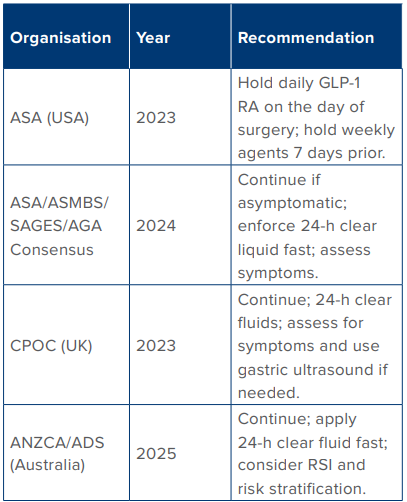
Table 1: Summary of recent international guidelines related to preoperative GLP-1 RAs. Abbreviations: ADS: Australian Diabetes Society; AGA: American Gastroenterological Association; ANZCA: Australian and New Zealand College of Anaesthetists; ASA: American Society of Anaesthesiologists; ASMBS: American Society for Metabolic and Bariatric Surgery; CPOC: Centre for Perioperative Care; GLP-1 RA: Glucagon-Like Peptide-1 Receptor Agonist; RSI: Rapid Sequence Induction; SAGES: Society of American Gastrointestinal and Endoscopic Surgeons; UK: United Kingdom; USA: United States of America.
Risk Mitigation Strategies
-
Enforce 24-hour clear fluid fasting in all GLP-1 RA–treated patients.
-
Incorporate GLP-1 RA use in preoperative screening and anaesthesia checklists.
-
Use point-of-care gastric ultrasound for high-risk or uncertain cases.
-
Consider erythromycin preoperatively in symptomatic patients.
-
Employ RSI and secured airway techniques for recent initiators or symptomatic individuals.
GLP-1 RAs are a burden in perioperative period that is often overlooked. Their delayed gastric emptying effects may quietly undermine preoperative fasting measures, which could raise the risk of regurgitation, aspiration, or airway compromise without any obvious signs. If not recognised, they could lead to complications that could have been avoided and make surgical outcomes worse. As their use becomes widespread, it is important to recognise their hidden effects and actively include ways to lessen them in perioperative workflows.
Conclusion
GLP-1 RAs represent a novel and under-recognised aspiration risk in the perioperative landscape. As their indications expand across endocrinology, hepatology, and preventive medicine, clinicians must develop pathways to identify and manage patients on these agents. Discontinuation alone is insufficient. A combination of screening, fasting modification, airway management, and inter-speciality communication is required. This commentary serves as a clinical whistleblower’s alert: GLP-1 RA awareness should be embedded into every pre-anaesthesia protocol, sedation checklist, and procedural plan.
Aparna Sinha. Glucagon-Like Peptide-1 Receptor Agonists and Aspiration Risk: A Perioperative Call to Action. MMJ. 2025, December. Vol 2 (4)
References
-
APEX Anesthesia Review. GLP-1 Anesthesia: Updated Perioperative Guidelines for CRNAs. Available at: https:// www.apexanesthesia.com/blog/glp-1-anesthesia-updatedperioperative-guidelines-for-crnas/. Accessed on: 3rd November 2025.
-
Anesthesia Patient Safety Foundation. Risk of regurgitation and aspiration with GLP-1 receptor agonists: Case reports and clinical concerns. APSF Newsletter. 2023;38(5):45–7.
-
Chen YH, Zink T, Chen YW, et al. Postoperative aspiration pneumonia among adults using GLP-1 receptor agonists. JAMA Netw Open. 2025;8(3):e250081.
-
Hoteit BH, Kotaich J, Ftouni H, et al. The dual impact of GLP-1 receptor agonists on metabolic and reproductive health in polycystic ovary syndrome: Insights from human and animal trials. Ther Adv Endocrinol Metab. 2025;16:20420188251383064.
-
Ma R, Ding X, Wang Y, et al. The therapeutic effects of glucagon-like peptide-1 receptor agonists and metformin on polycystic ovary syndrome: A protocol for systematic review and meta-analysis. Medicine. 2021;100(23):e26295.
-
Ghosal S, Datta D, Sinha B. A meta-analysis of the effects of glucagon-like-peptide 1 receptor agonist (GLP1-RA) in nonalcoholic fatty liver disease (NAFLD) with type 2 diabetes (T2D). Sci Rep. 2021;11(1):22063.
-
Rinella ME, Neuschwander-Tetri BA, Siddiqui MS, et al. AASLD practice guidance on the clinical assessment and management of nonalcoholic fatty liver disease. Hepatology. 2023;77(5):1797–835.
-
Wong S, Fabiano N, Zhou C, et al. Efficacy and safety of glucagon-like peptide-1 receptor agonists for treatment of obstructive sleep apnea: a systematic review and metaanalysis of randomized controlled trials. Psychiatry Int. 2025;6(3):111.
-
Malhotra A, Grunstein RR, Fietze I, et al. Tirzepatide for the treatment of obstructive sleep apnea and obesity. N Engl J Med. 2024;391(13):1193-1205. Erratum in: N Engl J Med. 2024;391(15):1464.
-
Baser O, Lu Y, Shuangrui C, et al. Tirzepatide and semaglutide for the treatment of obstructive sleep apnea and obesity: A retrospective analysis. Med Res Arch. 2025;13(1).
-
American Society of Anesthesiologists. American Society of Anesthesiologists consensus-based guidance on preoperative management of patients (adults and children) on glucagon-like peptide-1 (GLP-1) receptor agonists. Available at: https://www.asahq.org/about-asa/newsroom/newsreleases/2023/06/american-society-of-anesthesiologistsconsensus-based-guidance-on-preoperative. Accessed on: 3rd November 2025.
-
Ushakumari DS, Sladen RN. ASA consensus-based guidance on preoperative management of patients on glucagon-like peptide-1 receptor agonists. Anesthesiology. 2024;140(2):346–8.
-
Hocking SL, Scott DA, Remedios ML, et al. 2025 ADS/ ANZCA/GESA/NACOS clinical practice recommendations on the peri-procedural use of GLP-1/GIP receptor agonists. Anaesth Intensive Care. 2025;53(5):300–6.
-
Kindel TL, Wang AY, Wadhwa A, et al. Multi-society clinical practice guidance for the safe use of glucagon-like peptide-1 receptor agonists in the perioperative period. Surg Endosc. 2025;39(1):180–3.