 WhatsApp Us (24/7)
 +91 926 888 0303 (24/7)


Abstract: Aortic stenosis (AS) is a common heart valve disease, particularly affecting elderly populations. Surgical aortic valve replacement (SAVR) has long been the standard of care, but its invasive nature excludes many highrisk patients. Transcatheter aortic valve implantation (TAVI) has emerged as a less invasive alternative. It is a pioneering medical interventional procedure that has now become a standard procedure for treating patients with severe AS. The paper highlights TAVI's effectiveness, including its benefits, procedure protocols, and future perspectives, while also addressing its limitations and challenges.
Key words: Aortic Stenosis (AS), Surgical Aortic Valve Replacement (SAVR), Transcatheter Aortic Valve Implantation (TAVI).
Introduction
Structural heart diseases (SHD) include congenital or acquired defects affecting the cardiac valves, septa, or myocardium, which can lead to serious health issues if untreated. Among these, aortic stenosis (AS) is the most prevalent condition in elderly patients. It is a severe condition where the aortic valve narrows, restrictings blood flow from the heart to the body. Transcatheter aortic valve implantation (TAVI), a revolutionary approach for treating AS, is particularly beneficial for patients deemed high-risk for conventional surgery. Traditional surgical aortic valve replacement (SAVR) has high mortality rates in high-risk patients, making TAVI a valuable procedure due to its minimally invasive nature. A solution for the high-risk population is TAVI, which involves a conventional aortic valvuloplasty and the implantation of a biological prosthetic valve that has been stitched to a metallic stent and crimped onto a catheter. Since its first successful procedure in 2002, TAVI has rapidly developed, offering an alternative to open-heart surgeries and improving patient outcomes.1
Furthermore, in a randomised trial, transfemoral TAVI became the first treatment for AS to show improved survival and noninferiority when compared to surgery. This study demonstrated a 20% absolute reduction in mortality at one year after randomly assigning patients with severe surgical risk to medical treatment, such as valvuloplasty, as opposed to transfemoral TAVI.2
Aortic Stenosis
AS is a degenerative disease characterised by the calcification and narrowing of the aortic valve, limiting blood flow from the left ventricle to the aorta, causing increased ventricular pressure and primarily affecting older adults. It is primarily caused by degenerative calcification in the elderly, with a prevalence of 4.6% in patients over 75.³ AS can lead to heart failure, syncope, and sudden death if untreated. Traditionally, AS has been treated with SAVR; however, for those considered too high-risk due to age or comorbidities such as renal disease, pulmonary disease, liver disease, previous heart surgeries or severely frailty, TAVI has become a viable option. SAVR in such patients carries a surgical mortality risk of around 3-8%.
TAVI Procedure and Protocol
TAVI is a minimally invasive procedure that involves implanting a bioprosthetic valve using a catheter-based approach, avoiding the need for open-heart surgery. The procedure is typically performed through one of three main approaches: transfemoral,transapical, or subclavian, depending on the patient’s anatomy and vascular conditions.4 The transfemoral approach is less invasive, typically performed under local anaesthesia, while the transapical route requires general anaesthesia and a small thoracotomy. Valves are classified into two categories: balloon expandable and self-expandable. Preoperative assessment includes echocardiography, computed tomography (CT) scans, and catheterisation to ensure accurate valve sizing and assess the patient’s vascular status. The procedure is performed under conscious sedation. Access is typically obtained via the transfemoral approach, where a vascular sheath is introduced into the femoral artery. A guidewire is advanced into the vascular system and navigated to the heart, allowing the insertion of a delivery catheter that carries the prosthetic valve. The valve, which may be balloon-expandable or self-expanding, is positioned within the native aortic valve annulus. Deployment occurs via balloon inflation (in the case of balloon-expandable valves) or through self-expansion, which secures the valve in place while displacing the calcified leaflets.5 The placement of the valve is guided by echocardiographic and fluoroscopic imaging. Subsequent echocardiographic assessment is performed to evaluate the haemodynamic functioning and ensure optimal valve function, followed by sheath removal and closure of the access site. Post-procedure, patients are monitored for potential complications such as bleeding, stroke, or arrhythmias. In patients at high and intermediate risk, initial devices and techniques offered a promising alternative, despite the constraints of bleeding risk and the requirement for permanent pacemakers. As methodologies evolved over time, the device itself has become more efficient and exhibited lower complications. Recently, even in real-world patients with relatively low risks, TAVI has been proven to be comparable to SAVR. This makes it possible to name TAVI the preferred treatment for individuals with AS.
Benefits of TAVI
TAVI is a minimally invasive procedure. It employs a catheterbased approach, typically utilising the transfemoral route, which results in reduced surgical trauma and minimal perioperative pain compared to open-heart surgery.5-8 It enables faster recovery rates, thereby limiting long hospital stays.6-8 TAVI makes aortic valve replacement more accessible to a larger patient group by offering a feasible treatment option for those considered inoperable or at high surgical risk. Furthermore, TAVI can be performed using various access points, including the femoral, subclavian, and transapical approaches, based on the patient’s anatomical considerations.6,7 Clinical evidence demonstrates that TAVI is associated with substantial improvements in symptoms and quality of life metrics, as assessed by validated tools such as the Kansas City Cardiomyopathy Questionnaire and New York Heart Association classification. Longitudinal studies show that TAVI produces favourable haemodynamic results that last over time, with mortality and morbidity outcomes comparable to SAVR.
Challenges and Limitations of TAVI
After the procedure, aortic regurgitation is often observed. Aortic regurgitation is typically caused by the existence of small paravalvular leaks because of the valve's inadequate apposition brought on by severe nodular calcifications. This regurgitation is frequently improved with a second, highervolume balloon inflation within the valve.9,10 Another challenge during TAVI procedure is that up to 40% of patients undergoing the procedure face access-related complications such as haematomas, dissections, or arterial avulsions. Proper patient selection and advances in vascular closure devices are critical to reducing vascular complications. There is a 5% risk of cerebrovascular events like stroke, as a result of embolic debris dislodged during the procedure.11 Furthermore, approximately 10-30% of patients may require a permanent pacemaker postTAVI due to conduction block caused by the proximity of the valve to the bundle of His.12
Patient Outcome Data
Around 90% of TAVI procedures are successful worldwide, whereas the mortality rate at 30 days is less than 10% for transfemoral access and 15% for transapical access. According to the studies conducted, the results showed an absolute reduction of 20% in mortality rates (50.7% in medical treatment group vs 30.7% in the TAVI group).13 While TAVI is associated with more strokes and major vascular complications, SAVR is associated had more significant bleeding events and new-onset atrial fibrillation.
Over the last decade, the use of TAVI has resulted in a remarkable reduction in procedural failure and mortality rates. However, as TAVI is still a relatively novel procedure, limited research is available on the long-term durability of these valves. Current theoretical data and manufacturer insights suggest the valves are designed to last >10 years. According to all published research, the valves demonstrated good durability, maintained hemodynamic function, effective orifice areas greater than 1.5cm2, and showed no discernible gradient or new aortic regurgitation at three years.14
Future Directions
TAVI was initially used only for high-risk patients. However, it is now being considered for moderate-risk patients, with ongoing trials comparing it directly to SAVR in lower-risk populations. Lower-profile delivery systems are in development, which will enable more patients with small or tortuous vessels to undergo transfemoral TAVI.16 Improvements in valve designs, such as repositionable and retrievable valves, are being tested to reduce complications like valve mispositioning or regurgitation. Additionally, non-invasive imaging technologies aim to enhance pre-procedural planning and minimise complications arising from improper valve sizing.
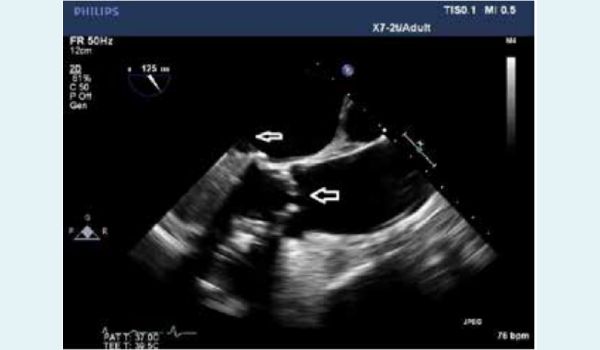
Figure 1: Transoesophageal echocardiogram of a patient undergoing transcatheter aortic valve implantation (TAVI) for rheumatic aortic stenosis with a prior prosthetic mitral valve. The small arrow indicates the preexisting mitral valve prosthesis in a patient with rheumatic mitral valve disease; the large arrow highlights rheumatic aortic stenosis with thickened valves and minimal calcification.15
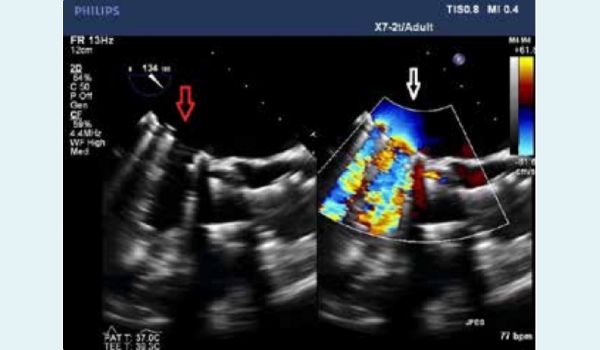
Figure 2: Transoesophageal echocardiogram showing a prosthetic mitral valve in a patient with rheumatic mitral stenosis undergoing transcatheter aortic valve implantation (TAVI). The red arrow indicates the prosthetic heart valve (PHV), while the white arrow shows the PHV with colour flow doppler.15
Conclusion
TAVI has revolutionised the treatment of aortic stenosis in high-risk patients, offering a life-saving alternative for patients deemed inoperable with conventional surgery. Its minimally invasive nature and favourable outcomes make it a valuable alternative to surgical valve replacement. With technological innovations and clinical experience improving outcomes, TAVI is expected to become more widely adopted across broader patient populations and further reduce complications, ultimately benefiting more patients with AS. Ongoing research into device optimisation and patient selection criteria will further establish TAVI as a standard care option for structural heart disease.
References
- Cribier A, Eltchaninoff H, Bash A, et al. Percutaneous transcatheter implantation of an aortic valve prosthesis for calcific aortic stenosis: first human case description. Circulation. 2002;106:3006-3008.
- Smith CR. Transcatheter vs surgical aortic valve replacement in high risk patients with severe aortic stenosis: Results from the PARTNER trial. ACC congress. New Orleans, April 3, 2011. Available from: http://my.americanheart.org/idc/ groups/ ahamah-public/@wcm/@sop/@scon/documents/ downloadable/ ucm_425332.pdf.
- Lester SJ, Heilbron B, Gin K, et al. The natural history and rate of progression of aortic stenosis. Chest. 1998;113:1109-1114.
- Lichtenstein SV, Cheung A, Ye J, et al. Transapical transcatheter aortic valve implantation in humans: initial clinical experience. Circulation. 2006;114:591-596.
- Zacharoulis A, Antoniades A, Frogoudaki A, et al. TAVR in patients with aortic stenosis and mechanical mitral valve. Int J Cardiol. 2015;180:226–227
- Ruparelia N, Prendergast BD. TAVI in 2015: who, where and how? Heart. 2015;101(17):1422-31.
- Escarcéga RO, Waksman R. Superior survival with transcatheter core valve over surgery in high-risk patients with aortic stenosis: good news for the Heart Team. Cardiovasc Revasc Med. 2014;15(4):191-2.
- Barbe T, Levesque T, Durand E, et al. Transcatheter aortic valve implantation: The road to a minimalist "stent-like" procedure. Arch Cardiovasc Dis. 2022;115(4):196-205.
- Moreno R, Calvo L, Salinas P, et al. causes-peri-operativemortalityafter-transcatheter-aortic-valve-implantation-pooledanalys. J Invasive Cardiol. 2011;23: 180-184.
- Huded CP, Allen KB, Chhatriwalla AK. Counterpoint: challenges and limitations of transcatheter aortic valve implantation for aortic regurgitation. Heart. 2021;107(24):1942-1945.
- Khera S, Koshy AN, Tang GHL, et al. Prevention and Management of Stroke After Transcatheter Aortic Valve Replacement: The Mount Sinai Stroke Initiative. J Am Heart Assoc. 2023;12(4):e028182.
- Moreno R, Dobarro D, López de Sá E, et al. Cause of complete atrioventricular block after percutaneous aortic valve implantation: insights from a necropsy study. Circulation. 2009;120:e29-e30.
- Leon MB, Smith CR, Mack M, et al. Transcatheter aortic-valve implantation for aortic stenosis in patients who cannot undergo surgery. N Engl J Med. 2010;363:1597-1607.
- Gurvitch R, Wood DA, Tay EL, et al. Transcatheter aortic valve implantation: durability of clinical and hemodynamic outcomes beyond 3 years in a large patient cohort. Circulation. 2010;122:1319-1327
- Kumar V, Dhir S, Yadav MK. Transcatheter Aortic Valve Replacement (TAVR) in rheumatic heart disease patients with pre-existing mitral valve prostheses: A single center report of 9 cases (in press).
- Pasic M, Unbehaun A, Dreysse S, et al. Transapical aortic valve implantation after previous aortic valve replacement: Clinical proof of the “valve-in-valve” concept. J Thorac Cardiovasc Surg. 2010; Epub ahead of print.