 WhatsApp Us (24/7)
 +91 926 888 0303 (24/7)


Background
Historically, the survival of the elderly requiring ECMO support has been poor. Hence, there has been a reluctance to offer ECMO to patients above 65 years of age. Here, we have a case of an 80-year-old man with severe COVID-19 ARDS successfully treated with prolonged VV ECMO, which may perhaps encourage doctors to select the elderly for ECMO carefully.
Case: 80-year-old male with an active lifestyle, a known case of ischemic heart disease, presented with 5-day history of cough and generalised weakness in respiratory distress. He had possible aspiration due to vomiting at home and was hypoxic with 84% sats at room air. The initial NIV trial failed and the patient was intubated the same day. His gas exchange deteriorated rapidly and required 100% Fio2, high PEEP 12 cm h2o. In spite of proning, PF remained below 70 and PaCO2 increased to 60mmhg.
The patient was diagnosed with COVID-19 Pneumonia with ARDS, AKI and Cytokine Storm {creatinine 2.8mg/dl, IL6 >5000pg/ml CRP 144mg/dl}.
Considering his active lifestyle, short history, just one day on an invasive ventilator, minimal vasopressor support and various clinical severity scores favouring survival, we decided to initiate VV ECMO for him.
ICU SCORES: RESP score: 3 (76% of survival rate)
PRESERVE score: 6
PRESET score: 1
SOFA: 4
SAPS2: 51
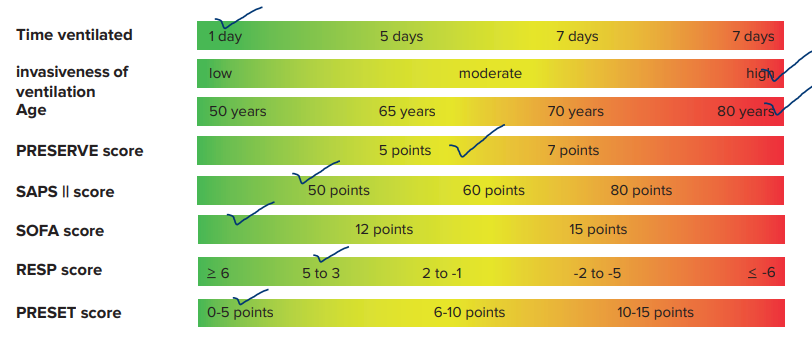
Figure 1: ICU Scores of the patient
Due to cytokine storm and AKI, the patient was provided CRRT with Cytosorb for Hemadsorption in parallel with VV ECMO. Ultra lung protective ventilation was provided with a 4 ml/kg Tidal volume and RR 12.
The patient required appropriate antibiotics and antifungals for secondary lung and urine infections. Surveillance cultures were sent every 7th day. Bloodstream fungal infection was managed with antifungals without changing the ECMO cannula.
Percutaneous tracheostomy was done on the 10th day of admission with ongoing Heparin for ECMO. However, his lungs failed to improve in spite of one month of ECMO support. We also provided inhaled nitric oxide.
We decided to continue the aggressive care with the support of relatives. The oxygenator was changed once. Finally, after 45 days of persistence, we could get him off VV ECMO and he required another 47 days to get him off the Ventilator.
The patient was discharged home after mobilisation with Nasal prongs oxygen in the alert state without any neurological deficit after 92 days of hospitalisation.
| Study Age defining | Age defining “Elderly” | No. of patients included total | Hospital mortality in the “Elderly” |
|---|---|---|---|
| Mendiratta et al. 2014 [6] | >65 | 368 | 59% |
| Karagiannidis et al. 2016 [7] | >80 | 1944 | 76% |
| Deatrick et al. 2020 [8] | >65 | 182 | 83% |
| >55 | 43% | ||
| Giani et al. 2021 [9] | >65 | 144 | 56% |
Table 1: Evidence for the use of VV ECMO in elderly patients and the respective outcomes
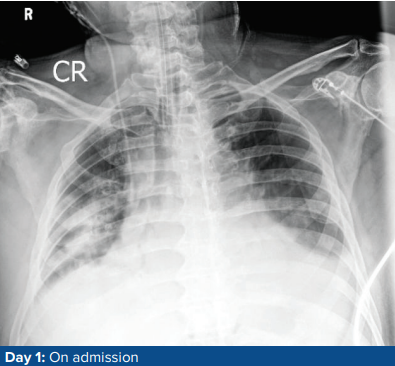
Figure 2: X-Ray report on the day of admission
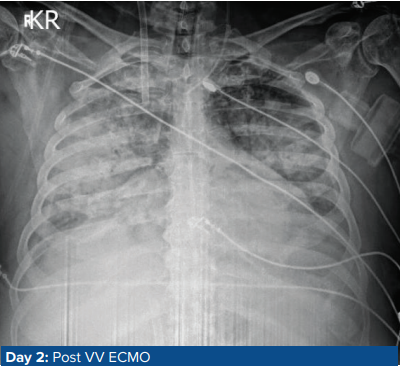
Figure 3: Post VV ECMO at Day 2
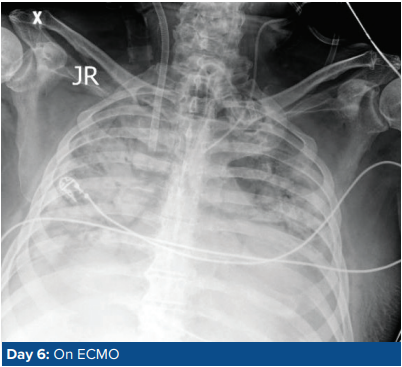
Figure 4: X-Ray report on day 6 of ECMO
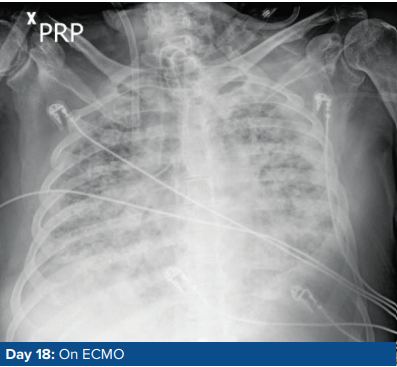
Figure 5: X-Ray report on Day 18 of ECMO
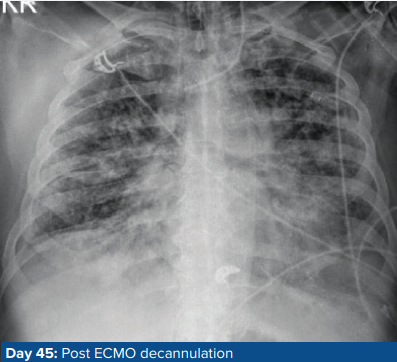
Figure 6: X-Ray report on day 45
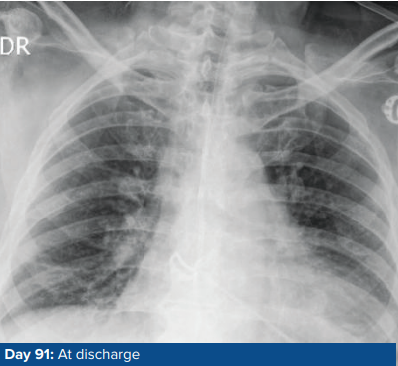
Figure 7: X-Ray report on day 91
| Events | Date | Ecmo day | Comments |
|---|---|---|---|
| Symptoms Began | 09-09-2022 | - | - |
| Covid Positive | 10-09-2022 | - | Rtpcr+ |
| Icu Admission Intubation | 13-09-2022 | - | Respiratory failure |
| Ecmo Cannulation Crrt+Cytosorb | 14-09-2022 | 1 | Oxygenation and Ards continued worsening with poor renal function |
| Atrial Fibrilation | 16-09-2022 | 3 | Cardioversion labile |
| Oxygenator Change | 19-09-2022 | 6 | Hemodynamics thrombus on oxygenator mambrane and oxygenation deterioration |
| Tracheostomy | 21-09-2022 | 8 | With heparin dose adjustment to target act 120-130 |
| Crrt Weaning | 22-09-2022 | 9 | Better renal function |
| Crrt Restart | 01-10-2022 | 20 | Poor renal function |
| Crrt Stopped | 08-10-2022 | 28 | Better renal function |
| Off Ecmo Support | 28-10-2022 | 45 | Ventilator at 40% |
| Tracheostomy | 08-12-2022 | 85 Days | Fio2 |
| Decannulation Discharge | 14-12-2022 | 92 Days | Weaned of from ventilator mobilised to chair and walk |
Table 2: Events with date and ECMO day details
Discussion
Extracorporeal Membrane Oxygenation (ECMO) is increasingly used to treat acute respiratory distress syndrome[1]. ELSO registry points out that 4361 patients requiring ECMO for respiratory failure had a mean duration of 22 days on ECMO[2]. There are anecdotal reports of prolonged ECMO support of 265 days without complications. One patient received ECMO for 403 days while waiting for a lung transplant but succumbed soon after decannulation[3,4].
Our case demonstrates that successful VV ECMO for a long period of 45 days with complete recovery of lung function is possible in elderly patients of 80 years with severe Covid 19 ARDS and with multi-organ dysfunction.
The factors responsible for successful outcomes in patients with ARDS requiring VV ECMO can be several:
-
ECMO to Rescue Lung Injury in Severe ARDS (EOLIA) study, patients with ARDS received immediate ECMO if indicated by one of the three criteria:
1. PaO2/FiO2 ratio <50 for more than 3hrs
2. PaO2/FiO2 ratio <80 for more than 6 hrs
3. Arterial blood pH <7.25 with PaCO2 >60 mmHg for over 6hrs3
The decision to initiate VV ECMO in above patient was quick, within 48 hrs of admission, when PF ratio (<70) failed to improve despite proning and there was hypercarbia (paCO2 >70) as well.
-
We practised strict infection control practices per ELSO’s guidelines on patients with Covid 19[5]. The patient was managed in an isolation room with dedicated nursing staff. ECMO team members strictly followed hand hygiene and used PPE and N95 masks.
Sanitisers were kept on three sides of the bed. Surveillance cultures were sent every 7th day to pick up harbouring infections early on before hemodynamic compromise. Microbiology backup was excellent.
-
Thrombotic complications and coagulopathy are frequent in Covid patients[3]. In addition, bleeding and thrombosis are serious complications during the use of ECMO[4]. The data suggests that using ECMO in Covid 19 may be challenging, particularly if prolonged support is needed. We monitored platelets, APTT, D dimer, Fibrinogen and FDP to detect thrombotic, bleeding and haemolysis complications.
Multi-disciplinary team efforts between Critical Care Specialists, Pulmonologists, Nursing care, Physiotherapists, Nutritionists, Nephrologists and Perfusionists are required for such critical patients to get positive outcomes.
CONCLUSION:
Age is just a number and should not restrain Critical Care Specialists from providing ECMO support for ARDS in elderly patients, especially those with active lifestyles and a reasonable chance of survival. We recommend using the protocol provided in reference 16 to decide the initiation of VV ECMO. It may take an unexpectedly long time to see clinical improvement, which may doubt the usefulness of such costly treatment. However, as long as the patient is neurologically intact, it may be justified to persist with the efforts.
References
- Cho HJ, Li Bassi G, Jung JS, Shekar K, Jeong IS, Heinsar S, et al. ECMO use in COVID-19: a narrative assessment based on lessons learned from previous respiratory virus outbreaks. 2020; 24(3):301; doi: 10.1186/s13054-020-02979-3
- FH Andersen, R. Kvale. Do older patients in intensive care units have a greater death rate and receive less intensive care? 2012;56:1298–305. 10.1111/j.1399–6576.2012.02782.x Acta Anaesthesiol Scand [PubMed] [Cross Reference] [Scholar Google]
- Iba T, Thachil J, Levi M, Warkentin TE, Levy JH, Connors JM. The distinctive features of coagulopathy caused by COVID-19. 2020; 24:360. doi: 10.1186/s13054-020-03077-0. Crit Care.
- Blood loss and thrombotic issues when using extracorporeal membrane oxygenation: Thomas J, Kostousov V, Teruya J. (2018) 44:20–9. doi: 10.1055/s-0037-1606179 Semin Thromb Hemostasis
- Shekar K, Peek G, Badulak J. The International Group of Multi-disciplinary Extracorporeal Membrane Oxygenation Providers has produced a consensus document titled “2019 Interim Guidelines for Extracorporeal Life Support Organization Coronavirus Disease.” doi: 10.1097/ MAT.0000000000001193. ASAIO J. (2020) 66:707–21
- Mendiratta P., Tang X., Rycus P., Brogan T.V., Collins R.T., 2nd, and Prodhan P. A review of the Extracorporeal Life Support Organization registry about extracorporeal membrane oxygenation for elderly patients experiencing respiratory failure. 2014;60:385–390 in ASAIO J. Am. Soc. Artif. Intern. 10.1097/MAT.0000000000000090 is the doi
- Karagiannidis C., Brodie D., Strassmann S., Philipp A., Bein T., Muller T., Windisch W.: The evolution of mortality and epidemiology in extracorporeal membrane oxygenation. 2016;42:889–896. doi: 10.1007/s00134-016-4273-z. Intensive Care Med
- Deatrick K.B., Mazzeffi M.A., Galvagno S.M., Jr., Tesoriero R.B., Kaczoroswki D.J., Herr D.L., Dolly K., Rabinowitz R.P., Scalea T.M., Menaker J. Outcomes of Venovenous Extracorporeal Membrane Oxygenation When Stratified by Age: How Old Is Too Old? ASAIO J. Am. Soc. Artif. Intern. 2020;66:946–951. doi: 10.1097/MAT.0000000000001076
- Giani M., Forlini C., Fumagalli B., Rona R., Pesenti A., Foti G. Indication for Venovenous Extracorporeal Membrane Oxygenation: Is 65 Years Old, Too Old? ASAIO J. Am. Soc. Artif. Intern. 2021;67:e55. doi: 10.1097/ MAT.0000000000001273